|
|
One of the strongest desires that comes to the traveler is the desire to carry home some souvenir from each place he has visited. It is a feeling that comes to almost everyone, and is bred of the hope that some little thing, perhaps beautiful, perhaps strange, or bizarre, or perhaps useful, will keep fresh in the mind the memories of places visited, places that have given a little pleasure on long dreamed of journeys through distant lands. A waterfall cannot be transported, the mountains are solid and immovable, the mesas and deserts cannot be lifted from their settings, so the natural thing to do is to carry away something associated with these thing, something that will always bring back to mind the memories of them. As a result of this demand the souvenir trade has been so overdone that no matter where the traveler goes he is constantly assailed with a great variety of novelties and gimcracks that may only by a great stretch of the imagination be called souvenirs. A few of them have real value, but most of them are worthless and are discarded in a short time. The traveler in this region known as "The Southwest" has an opportunity to obtain an article which is perhaps the most perfect of all souvenirs, for not only is it beautiful and strange, but it is useful to the point that it can compete successfully with similar articles of the white man's making. For souvenir value the Navaho Blanket has no rival—it answers every requirement. Beautiful in that it is the highest artistic development of an unusual people, bizarre in that it carries the breath of the canyons and mesas and the spell of the deserts useful in that it may be subjected to the most devastating wear and still outlive its machine-made brother. As a rug, laprobe, bedcover, wall decoration, or heavy blanket for outings it has no equal, and because of the fact that it is a human document telling of the patient toil of painstaking fingers it brings a feeling of intimacy that will grow upon the owners as the years cause the blanket to mellow and soften. Very often the person buying a Navaho Blanket wonders about the story back of these interesting articles. Where and when and how did they originate? Is blanket making a native Navaho art or a borrowed art? And above all other questions; "How shall I know a good Navaho Blanket?" The story of the Navaho Blanket had its beginning many centuries ago and of the early part of the story we know very little. Weaving in America is probably as old as man himself, for with the earliest remains we find basketry and twined furs. Cotton cloth first made its appearance about the beginning of the Christian era, and in the prehistoric Pueblo dwellings we find it developed to the point where they are making tightly and smoothly woven cloth, similar to our coarser grades of flannels. When the Navahos first began to weave is not known but there is no doubt that the greatest development came after their contact with the Pueblos and their adoption of the Pueblo Indian loom. Being of the Athapascan stock the Navahos had probably used the native Athapascan loom, but arriving in the southwest about the thirteenth or fourteenth centuries they found the pueblos using a much better loom which they immediately appropriated. The first looms obtained from the Pueblos were probably stolen, along with enough owners to instruct the Navahos in their use. The Navaho has never been averse to taking by force anything that he sees other people using, and he has the happy faculty of being able to develop his "borrowed" arts until he masters them completely, and advances far beyond the more inventive people from whom he did the "borrowing." The Pueblo Indian at the present time weaves very little, while the Navaho is the most prolific and finest weaver known.
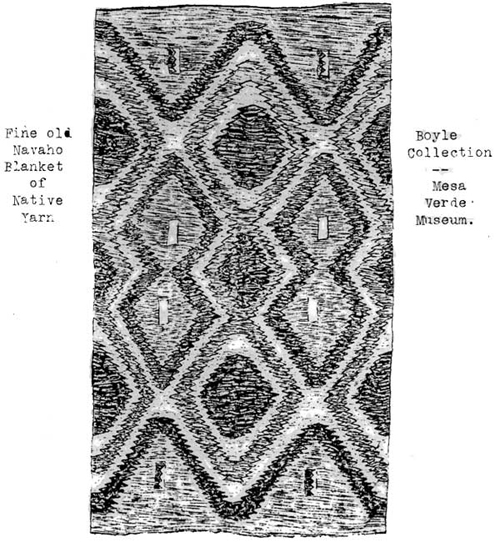
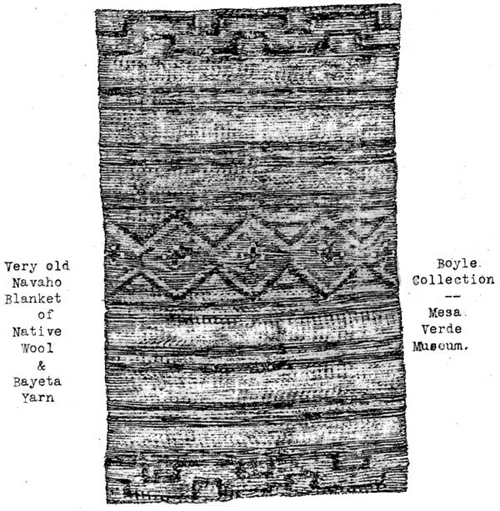
Up until the time of the coming of the Spaniards the blankets were all of cotton, for sheep were not native to this continent. About the end of the sixteenth century, however, Onate, the Spanish explorer, brought sheep into the southwest and left some of them with the Pueblo Indians. These the Navahos promptly "borrowed," and again he excelled his master, for the Navahos now have about one million head of sheep, while the Pueblos have a mere handful. With the advent of wool, the weavers had the perfect weaving medium, and the great Navaho Blanket making era had its beginning. The early products of the looms were the native wool, vegetable dye rugs which were the most truly Navaho of all the rugs that have been made, for everything used in them was the work of the Indian women. Early in the blanket-making era the Mexicans brought indigo to the weavers and this immediately took the place of the vegetable blue which had been the most difficult of all the colors to make. The colors in these early rugs were white blue, black, red, yellow, and green. About the beginning of the eighteenth century there came into the Southwest a new material for blanket making which was responsible for some of the finest blankets ever woven. This was bayeta, a cloth introduced by the Spaniards and promptly seized up on by the eager weavers. Their first bayeta they probably obtained from the discarded uniforms of the Spanish soldiers, and the Spaniards sensing a new trade, began to import the cloth. This the squaws unraveled, retwisted into yarn, and wove into blankets. Red was the predominate color at first, but in a short time other colors appeared, and were used to a certain extent. Often the bayeta was used in combination; into a blanket of native wool was woven a design with the red bayeta yarn. Being made of smooth, fine yarn, and with the patience and skill of the early weavers the bayetas are the finest examples of this Navaho art. Not a great many are still in existence but those that have been preserved stand as a monument to the patient squaws who wove them. The weave is fine and even, the designs are true old Navaho designs, and the colors are soft and well blended. So carefully were they dyed that blankets woven well over a century ago have not lost their original colors. The native wool, vegetable dye blankets and the bayetas were without interruption until about 1875, when a great change came over the blanket making industry. The traders, finding a ready market for the blankets, urged the Indian women to make more and more of them, and helped in this speeding up process by introducing aneline dyes and commercial, or Germantown, yarns. Dying with the aneline dyes was much quicker and easier than with the vegetable dyes and unusual colors began to appear. Many of the traders sold the commercial yarns to the weavers, who merely wove the blankets, often in such a hurry that the work was poor. Although a few of the blankets woven in this period were good the general result was a decline in the quality and the industry was seriously threatened, for the public, becoming aware of the inferior goods refused to buy. The traders themselves were the ones who returned the art to its former high level, for, realizing, that their greatest source of revenue was threatened, they banded together in an effort to improve the quality of the blankets.
The weavers were urged to do better work, and often the traders refused to buy the slipshod articles. Fairs were held, and prizes were given for the finest work. The traders no longer sold the Germantown yarn to the weavers and they were allowed to use only the best of the aneline dyes. At the present time the weavers are being encouraged to reproduce the atypical Navaho designs that appeared on the old rugs, and in the Chin Lee district they are being encouraged to use the old vegetable dyes. The result of all this is that the Navaho Blanket has returned to its former high level of excellence and it is safe to say that some of the blankets being woven today are as good as any that have ever been woven, and that the general average of all modern rugs is as good as at any other time in their history. True, some of the dyes are commercial dyes, but they are the best that can be obtained and the bright, un-Navaho colors are being eliminated. The cotton warp is a thing of the past and the copying of the old designs is eliminating many of the strange elements borrowed from the white man. The buyer of a Navaho rug may be sure that he is getting a pure product of the Indian, and by following a few simple rules may be sure of getting a good quality rug. He need have no fear of getting an imitation, for there is no such thing. The Navaho rug cannot be made by machinery, and there is no white man with the patience to weave one. From beginning to end the blanket has been the product of the Indian women, and represents weeks or even months of toil. Having always to care for her flock of sheep. and perform her regular household duties she is able to snatch only an hour or two in the morning and again in the afternoon when she can work on her blanket. Slowly it grows, following always the design that she carries only in her mind. When at last it is completed she mounts her horse and carries it to the trading post, where she exchanges it for supplies. The trader may sell the blanket to some traveler, or he may send it to a wholesale rug dealer who sends it to some other dealer over the country. The traveler in the Southwest often has the opportunity to see the blanket maker at her loom, and at any of the licensed trading posts along the road will find a good assortment of blankets from which he may buy as he chooses. Those who do not have the opportunity to visit the reservation will find reliable dealers in almost every city. Although there are a few simple rules about blanket buying that will be set forth in a later issue the best single rule to follow is; "the blanket that pleases the prospective purchaser most is the blanket for him to buy, irrespective of the price." No matter where it is obtained the Navaho Blanket will always bring to the observer memories of the strange land from which it came. He will see again the giant mesas, the yawning canyons, the vivid colors of the Painted Desert, the shimmering heat of the wastelands. Again he will see the patient Indian woman, who, spending her life in the midst of these natural wonders is able to weave into her blanket some of the beauty of this unusual region, the "Southwest." (TO BE CONTINUED) | ||||||
| <<< Previous | > Cover < | Next >>> |
vol3-3g.htm
14-Oct-2011