|
|
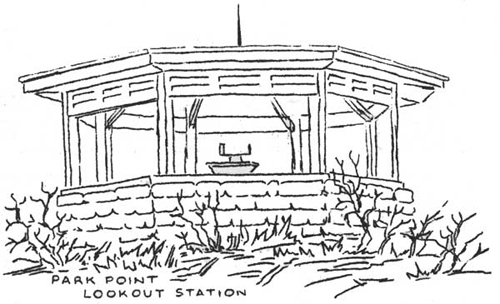
Mesa Verde National Park, so aptly described by the Spaniards as "Mesa Verde," could be as aptly renamed by circumstances the "Mesa Destruida." Forest fire, bane of all forested areas, could accomplish this destruction within a few hours, without apparent effort, or leave a ghastly scar in its wake devoid of all living things. Fire and fire fighting have preference over all other Park activities, except the safeguarding of human life. That means it is so important that when the alarm is sounded all concerned are at attention, and the entire organization is on its toes waiting for the never-desired second call for reinforcements. It may be likened to an armed camp, each key man with a definite routine. Men, equipment, supplies, communication, and transportation are the major details which must be considered. One of the most important phases of fire fighting is the detection system. The lookout observers are the eyes of the organization and when they fail the organization fails. August 1939, saw the completion of the Park Point Lookout Station. This building completes another link in our fire suppression chain and is one of the finest structures of its kind in the Service. It has a commanding view of almost the entire park area and the surrounding country and offers cooperative detection service to the Indian and Forest Services. Roughly, the observer can scan about 20,000 square miles. The station is equipped with Osborne fire finder, field glasses, maps, and a complete fire weather station which leaves nothing to be presumed. Sleeping and cooking facilities are also provided within the lookout so the lookout observer is always on hand. The duties of the lookout observer at Park Point are numerous. He reports by telephone to the fire dispatcher in the Chief Ranger's office six times daily under ordinary conditions. He keeps records of the fire weather instruments and scans the entire country approximately four times an hour. He records the path of all storms, location of all lightning strikes, and the presence or the absence of haze. He records the location of habitual smokes and intently watches each area of lightning strikes after a storm has abated. When a smoke is seen he immediately studies the area with field glasses noting the color of smoke, size of fire, wind direction, time of the day, and takes a reading (Azimuth) with the Osborne fire finder and also reads the vertical angle. By correlating his reading with a topographic map and panoramic photographs he determines the distance of the fire from Park Point and its location. He then calls the fire dispatcher and relays this information. Thereafter he does not leave his station but reports all conditions as they arise.
In the early dark ages of fire suppression and fire presuppression the human element entered into operations more than was desired. However, accomplishments were good even under those conditions. During the past few years great strides have been made in the prediction of fire weather. Instead of a ranger taking observations based on his personal experiences, which may have been little or great, the ranger now has instruments which give an index as to what may be expected under certain conditions. It is surprising how these conditions will repeat although there is always the prospect of the unforseen and critical factor arising. Briefly, the instruments used are as follows; a hygrothermograph which records on weekly charts the temperature and humidity, an anemometer and wind vane which give the wind velocity and wind direction, and a duff hygrometer, an instrument obtaining a rattan cord which flexes or relaxes with the variation of the moisture of the duff and litter of the forest floor. In addition there are the fuel moisture sticks, 3 one-half inch wooden cylinders that are placed in a typical forest situation and weighed daily to determine the amount of moisture they contain. The data from these instruments are combined to give us a definite index of fire danger. Under ordinary conditions the percentage of fire danger increases with the dry periods of late May and June, although at any time the danger meter may skyrocket with a high wind. The percentages are divided into five classes and each higher class calls for different plans and precautions, until we reach the extreme class when practically all activities are curtailed, fire crews are awaiting the alarm, emergency guards are hired, and leave and vacations are cancelled. Suppose we trace a typical fire call. The smoke is sighted by the Park Point lookout observer, and the information described above is relayed to the dispatcher who records all data. The dispatcher then consults his visibility maps to see if the fire is visible from another lookout tower. The same information, relayed by another lookout, will enable the dispatcher to draw intersecting lines and accurately plot the position. Type cover maps will give him the type of fuel in which the fire is burning and the travel time map will determine the amount of time required to reach the area. A first call alarm is then sounded and the ranger in charge proceeds to a designated spot with a completely equipped truck and picks up a flying squadron of seven men. If the get-away time (the time that elapses between the receipt of the lookout's report and the departure of the crew) exceeds five minutes inquiry made into the cause of the delay. The crew proceeds by the fastest route and when the site of the fire is reached work begins immediately. The ranger makes a reconnaissance to determine danger spots and attack point. As soon as conditions allow radio communication is established with Headquarters, giving all information to the dispatcher, and reporting that the crew can handle the fire or needs reinforcements. The ranger records for later reference the travel time, time of arrival, time of first attack, time the area is controlled, mop-up time, and the time when the fire is declared out. The methods used in fire suppression are many and varied. If a fire is located so that we can reach it with our pumper-tank truck the work is made easier for the proper use of water in forest fire suppression is miraculous. We do not mean to infer that it is the sole answer to the problem but corralling and controlling are simplified. More often our fires are located in remote sections where the use of water is impossible. The direct method may be used wherein the fire line is attacked directly at the burning edge and all burning material is thrown into the fire. If the indirect method is used a fire line is constructed some distance in advance of the fire and the fighters resort to backfiring. When the parallel method is used a fire line is constructed some distance away and all intervening materials are burned out immediately, or a line may be constructed not over two feet away, to leave as little material to burn as possible. Again, the whole situation may call for a variation of attack and combinations of the above methods may be used, taking advantage of every natural barrier. After all this is done the fire may jump its lines and run like a scared rabbit and the work must be done all over again. Fire fighting is now a science, yet the factors are variable and can never be depended upon to do the expected thing. Lightning will set fires in spite of an inch of rain, a visitor may flip a cigarette, a local resident may burn brush, or a fire may start from no apparent cause. Detection and organization are the keynote of success; a few minutes lost may allow a run to start which will turn a small smoldering fire into a conflagration. At times all possible speed, the right method of attack, and the right equipment will prove of no avail and many hours of anxiety and hard labor will result. The value of the work of the men of the Civilian Conservation Corps in the prevention and suppression of fire is hard to estimate. Since 1933 the CCC enrollees have been the backbone of the Mesa Verde fire fighting organization. They have served as lookout observers, fire dispatchers and fire fighters. Many long hours of tedious labor have been freely given and the enthusiasm of the men has made our program a success. | ||||||
| <<< Previous | > Cover < | Next >>> |
vol9-1c.htm
14-Oct-2011