

|
ARTILLERY THROUGH THE AGES A Short Illustrated History of Cannon, Emphasizing Types Used in America |
 |
PROJECTILES (continued)
FUZES
The eighteenth century fuze was a wooden tube several inches long, with a powder composition tamped into its hole much like the nineteenth century fuze (fig. 42c). The hole was only a quarter of an inch in diameter, but the head of the fuze was hollowed out like a cup, and "mealed" (fine) powder, moistened with "spirits of wine" (alcohol), was pressed into the hollow to make a larger igniting surface. To time the fuze, a cannoneer cut the cylinder at the proper length with his fuze-saw, or drilled a small hole (G) where the fire could flash out at the right time. Some English fuzes at this period were also made by drawing two strands of a quickmatch into the hole, instead of filling it with powder composition. The ends of the match were crossed into a sort of rosette at the head of the fuze. Paper caps to protect the powder composition covered the heads of these fuzes and had to be removed before the shell was put into the gun.
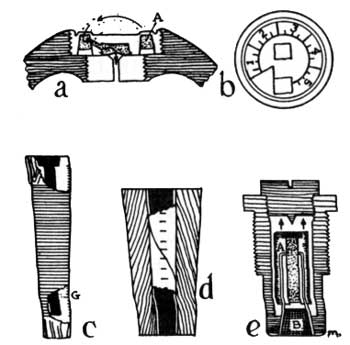
FIGURE 42—NINETEENTH CENTURY PROJECTILE FUZES.
a—Cross-section of Bormann fuze. b—Top of Bormann fuze.
c—Wooden fuze for spherical shell. d—Wood-and-paper fuze for
spherical shell. e—Percussion fuze.
Bombs were not filled with powder very long before use, and fuzes were not put into the projectiles until the time of firing. To force the fuze into the hole of the shell, the cannoneer covered the fuze head with tow, put a fuze-setter on it, and hammered the setter with a mallet, "drifting" the fuze until the head stuck out of the shell only 2/10 of an inch. If the fuze had to be withdrawn, there was a fuze extractor for the job. This tool gripped the fuze head tightly, and turning a screw slowly pulled out the fuze.
Wooden tube fuzes were used almost as long as the spherical shell. A United States 12-inch mortar fuze (fig. 42c), 7 inches long and burning 49 seconds, was much like the earlier fuze. During the 1800's, however, other types came into wide use.
The conical paper-case fuze (fig. 42d), inserted in a metal or wooden plug that fitted the fuze hole, contained composition whose rate of burning was shown by the color of the paper. A black fuze burned an inch every 2 seconds. Red burned 3 seconds, green 4, and yellow 5 seconds per inch. Paper fuzes were 2 inches long, and could be cut shorter if necessary. Since firing a shell from a 24-pounder to burst at 2,000 yards meant a time flight of 6 seconds, a red fuze would serve without cutting, or a green fuze could be cut to 1-1/2 inches. Sea-coast fuzes of similar type were used in the 15-inch Rodmans until these big smoothbores were finally discarded sometime after 1900.
The Bormann fuze (fig. 42a), the quickest of the oldtimers to set, was used for many years by the U.S. Field Artillery in spherical shell and shrapnel. Its pewter case, which screwed into the shell, contained a time ring of powder composition (A). Over this ring the top of the fuze case was marked in seconds. To set the fuze, the gunner merely had to cut the case at the proper mark—at four for 4 seconds, three for 3 seconds, and so on—to expose the ring of powder to the powder blast of the gun. The ring burned until it reached the zero end and set off the fine powder in the center of the case; the powder flash then blew out a tin plate in the bottom of the fuze and ignited the shell charge. Its short burning time (about 6 seconds) made the Bormann fuze obsolete as field gun ranges increased. The main trouble with this fuze, however, was that it did not always ignite!
The percussion fuze was an extremely important development of the nineteenth century, particularly for the long-range rifles. The shock of impact caused this fuze to explode the shell at almost the instant of striking. Percussion fuzes were made in two general types: the front fuze, for the nose of an elongated projectile; and the base fuze, at the center of the projectile base. The base fuze was used with armor-piercing projectiles where it was desirable to have the shell penetrate the target for some distance before bursting. Both types were built on the same principles.
A Hotchkiss front percussion fuze (fig. 42e) had a brass case which screwed into the shell. Inside the case was a plunger (A) containing a priming charge of powder, topped with a cap of fulminate. A brass wire at the base of the plunger was a safety device to keep the cap away from a sharp point at the top of the fuze until the shell struck the target. When the gun was fired, the shock of discharge dropped a lead plug (B) from the base of the fuze into the projectile cavity, permitting the plunger to drop to the bottom of the fuze and rest there, held by the spread wire, while the shell was in flight. Upon impact, the plunger was thrown forward, the cap struck the point and ignited the priming charge, which in turn fired the bursting charge of the shell.

|

|
|
|
Last Modified: Thurs, Sep 11 2003 10:00:00 pm PST |