

|
Popular Study Series History No. 5: Mountain Speech in the Great Smokies |
 |
Mountain Speech In the Great
Smokies*
By Joseph S. Hall, Former Technical Collaborator.
THE writer made a linguistic survey of the Great Smoky Mountains National Park and its environs during the summer of 1937 as a student technician of the National Park Service. The subjects of the study were primarily those native inhabitants who, for one reason or another, have been allowed to remain within the bounds of the park. In most cases the residents were elderly couples who expect to stay in their old homes for the rest of their lives and to whom yearly leases are granted by the Service. Other subjects were selected from areas immediately adjacent, especially those near sections of the park which have been abandoned completely by the original population. In many cases, speakers and informants who previously lived in what is now the park were interviewed. Altogether, a representative linguistic picture of the entire Smokies region was obtained.
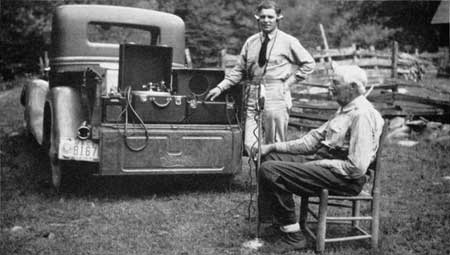 Steve Woody, a life-long resident of the Great Smoky Mountains, was 86 years old when this photograph was made while he described a bear hunt. A Civilian Conservation Corps youth is operating the controls of a machine which recorded Mr. Woody's speech as a part of a linguistic survey in Great Smoky Mountains National Park, North Carolina-Tennessee. |
Owing to the mountaineer's sensitivity and his apprehension of criticism, it was not found feasible to tell a subject that linguistic information was being collected. It was therefore necessary to gather data by indirect methods. Careful observation was made of the speech of hillsmen in their conversation together and in the writer's meetings with them on the road, in stores, and the like. The bulk of the information, however, was received during interviews in their homes. In such contacts it was necessary to tell the speakers that the Service was interested in gathering up old stories, accounts of the settlement of creeks and coves, tales of bear hunts, liquor-making, and similar materials.
In the large majority of cases it was possible to divert the subject with questions and get him or her to talking naturally. At such times linguistic notes were taken freely, although the reason for them ostensibly was to record the story or tale told by the speaker. The results of this method were successful and four field notebooks were filled with data pertaining to pronunciation, morphology, syntax, and vocabulary. All of the important vowel and consonant sounds and their variations were transcribed, and a word-list of some three or four hundred items was compiled.
Besides the linguistic data, there was a considerable residue of byproduct material, such as folk tales and folk history, and this has been assembled separately. In view of the complex nature of Great Smokies speech sounds, however, it was felt that the effectiveness of the phonetics study would be increased immeasurably by phonographic records of natural speech. Such records would make possible not only a more accurate description of the Great Smokies dialect, but also the preservation of specimens of local speech for future times. It, therefore, was thought to be urgently desirable to return to the area with a phonographic recorder before publishing the data collected. Since the entire linguistic study will be published as a doctoral dissertation, great regard necessarily is paid to accuracy and thoroughness.
A resumption of the study was made possible June 1939 by a fellowship awarded to the writer by Columbia University. The National Park Service endorsed continuance of the project by naming him technical collaborator and offering generous cooperation in every way. The Service provided a recorder, discs, a pickup truck for transportation of equipment, and office space in which to do the writing. Besides that recorder (use of which is limited to CCC camps and neighboring towns where alternating electric current is available, or where direct current may be converted to alternating current), the investigator equipped himself with a second one operating from a 6-volt, 200 ampere-hour battery. The latter machine has seen 2 years of service in Africa but, after thorough reconditioning, it continues to make good records. It may be taken up rough roads to remote mountain homes where it is set up on the pickup truck or on the porches of dwellings. The first machine cuts acetate discs, the second aluminum. It will be interesting to know which type of record is the more durable. Authorities feel at present that acetate provides more accurate reproduction, but that aluminum is more lasting.
Two methods are employed to elicit speech material for recording. One is to ask the speaker to read the story of Arthur the Rat. This little tale may be used for ready reference when one desires to know how a particular speaker pronounces a given word. Use of the story also is helpful when comparisons of the speech of two or more parts of the country are made. The other and principal method is to have a subject tell a story or event from his life experience. It is thought that a more natural utterance is evoked in this way. The results are surprisingly good, and cases of microphone fright have been far less frequent than anticipated.
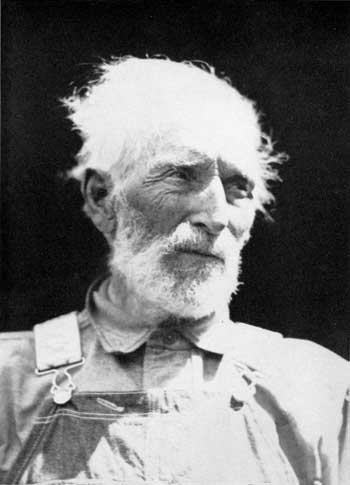 Aden Carver was a vigorous 93-year-old example of mountain man when he related for the recorder a story of his escape from a panther. A resident of the national park area, he was a consultant in the reconstruction of an early mountain mill. |
Men relate enthusiastically the stories of bear hunts in which they have participated and at times forget themselves so completely as to become dramatic. Women generally are more reluctant to talk into the microphone but, with a little urging, tell of old times, memorable experiences, and bygone methods of weaving and cooking. One elderly woman of the Oconaluftee River area declined the microphone, however, and informed the investigators: I don't fancy no sich as that and I won't jine up with ye!" Two men in a remote section near the park thought they were about to broadcast over the radio when the recorder was placed before them.
Many of the records should be historically valuable some day for the contemporary culture which they preserve. The chief disadvantage lies in the fact that it is necessary to transcribe all the material on the record for reference. Moreover, a subject may continue his account for two or three record surfaces without pronouncing all the sounds required for a good phonetic transcription of his speech. On the other hand, what is lost in this respect is more than compensated by the natural idiom which he employs and the consequent opportunity for the investigator to discover linguistic archaisms and colorful expressions.
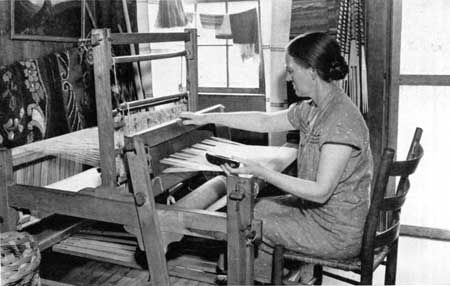 Mrs. Wiley Oakley weaving at a loom in the Great Smoky Mountains. |
All the speech material on the records will be transcribed eventually in the alphabet of the International Phonetic Association with modifications for American English as advised by the editors of American Speech and the Linguistic Atlas of the United States and Canada.
Because it was found possible in the previous survey to combine the collection of data on both speech and folklore, the writer continues to look for folklore material. Recordings of a number of old English ballads and traditional American pieces have been made. Among the former are Barbara Allen, Pretty Polly, William Hall, Jack the Sailor, The Butcher's Boy, and Pretty Sara; among the latter are Come All You Texas Rangers and Cindy. The musical field will not be covered thoroughly, of course, but at least there will be specimens recorded while it still is possible to preserve them. Two recordings made at an outdoor square dance at Bryson City, N. C., are notable for their dance calls and the reflection of the crowd's enthusiasm.
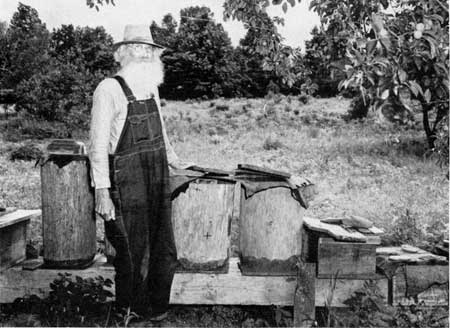 "Uncle" Dan Meyers, of Cades Cove in Great Smoky Mountains National Park, shown with his beehives fashioned from tree trunks. |
Careful observation is taken of local plant and animal names, of old remedies for ailments, and of customs, superstitions, and the like. Most of this material never will be captured by the phonographic disc; but in some cases it may be possible to induce a woman to tell her favorite home remedies or her superstitious beliefs into the microphone. Stories of events which, as a result of exaggeration and imaginative embellishment, have passed into the folklore stage, should be obtained easily.
It is contemplated that duplicates of all the outstanding records will be made, one set to go to Columbia University and the other to the National Park Service. Because campfire entertainment constitutes a feature of the Service program, it is conceivable that the best records of speech and music may be used ultimately for the diversion and enlightenment of park visitors. Such records would combine well with motion pictures portraying the scenery and culture of the Great Smokies. This use of the discs, however, would require pressings of the commercial type, for a number of copies of the same recording would be needed and the originals should be saved.
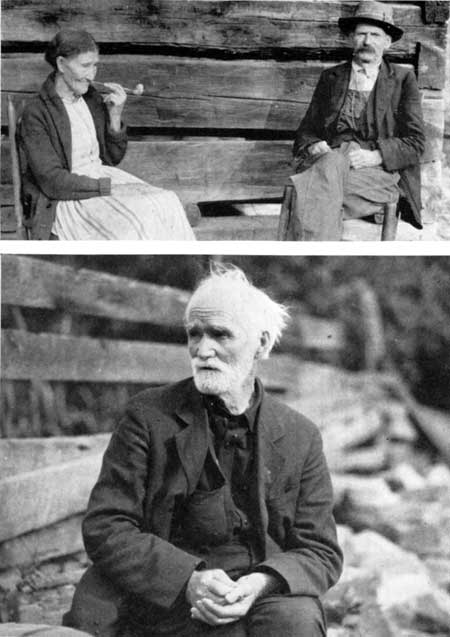 At the top is seen a mountain couple on the porch of a hewr. log home near Gatlinburg, Tenn. At the bottom is Mack Hannah, octogenarian resident of the park, whose speech was recorded for linguistic study. |
One question which it is hoped the phonographic survey may aid in solving is whether mountain speech represents a survival of Elizabethan English, as some romantic writers have claimed. One cannot deny that fourteenth, fifteenth, and sixteenth century forms persist in the Great Smokies. Ax for ask occurs in Chaucer and in the Wycliffe, Tindale, and Coverdale Bibles. Foutch for fetch is found in the fourteenth century Cursor Mundi and in the fifteenth century Townely Mysteries. The expression, to spend one's opinion, heard in the sentence, "I'd rather not spend my opinion," was used by Shakespeare in Othello. Use for to dwell or to inhabit, which appears in one of the phonograph records in the sentence, "We located a big bear and found where he was a-usin'," was employed by Beaumont and Fletcher. Spenser and the people of the Great Smokies agree in the pronunciation swinge for singe.
* * * * * * * * * * * * * * * * * * * * * * * *
American Shibboleths of Today
Jephthah, it is related in the Book of Judges (XII), employed the Hebrew word shibboleth as a test at the passage of the River Jordan to distinguish the Ephraimites, who were unable to pronounce the combination sh, from the men of Gilead.
With similar if more complex aims, students of American linguistics have adopted generally the somewhat tragic chronicle of Arthur the Rat, a hero whose habitual indecision cut short his rodent's career. The little story serves as a kind of phonetic yardstick for measuring the accents of northerner, southerner, easterner, or westerner, because it contains all the important sounds of the English language. The tale of Arthur, with its many shibboleths, follows:
Once there was a young rat named Arthur who never could make up his mind. Whenever his friends asked him if he would like to go out with them, he would only answer, "I don't know;" he wouldn't say yes or no either. He would always shirk making a choice. His Aunt Helen said to him, "Now look here! No one is going to care for you if you carry on like this. You have no more mind than a blade of grass."
One rainy day the rats heard a great noise in the loft. The pine rafters were all rotten, so that the barn was rather unsafe. At last the joists gave way and fell to the ground. The walls shook, and all the rats' hair stood on end with fear and horror. "This won't do," said the captain; "I'll send out scouts to search for a new home."
Within 5 hours the 10 scouts came back and said, "We found a stone house where there is room for us all. There is a kindly horse named Nelly, a cow, a calf, and a garden with an elm tree."
The rats crawled out of their little houses and stood on the floor in a long line. Just then the old rat saw Arthur. "Stop," he ordered coarsely. "You are coming of course."
"I'm not certain," said Arthur, undaunted. "The roof may not come down yet."
"Well," said the old rat, "we can't wait for you to join us. Right about face! March!"
Arthur stood and watched them hurry away. "I think I'll go tomorrow," he said calmly to himself, "but then again I don't know; it's so nice and snug here." That night there was a big crash. In the foggy morning some men with some boys and girls rode up and looked at the barn. One of them moved a board and saw a rat quite dead, half in and half out of his hole.
Yet most of the Elizabethan forms which survive in the Southern Appalachians continued in standard use into the seventeenth, eighteenth and (sometimes) the nineteenth centuries. Afeared occurs more than 30 times in Shakespeare, but it was also the prevailing form throughout the seventeenth century and thus cannot be said to be exclusively Elizabethan. Ballet for ballad was the common sixteenth century pronunciation (although Shakespeare was ballad), but it flourished also in the seventeenth century, being used by Pepys among others. Examples of not to care to for not to mind, as in a sentence spoken by an Emerts Cove man, "She don't care to talk," meaning, "She doesn't mind talking," are found in both the sixteenth and seventeenth centuries. (It is interesting to note in the English Dialect Dictionary that this sense of the phrase survives dialectally in Scotland.)
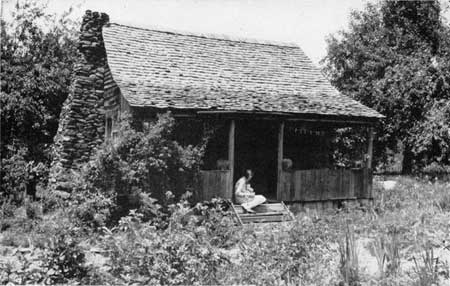 A home in the Great Smoky Mountains. |
Furthermore, the historical evidence does not favor the supposition that Southern Appalachian speech is an off-shoot of Elizabethan English. The region in question was peopled largely by emigrations from England, Scotland, and northern Ireland during the eighteenth century. It may be expected, therefore, that the area should contain numerous seventeenth and eighteenth century expressions, and such is the case. The pronunciation cowcumber for cucumber, now obsolescent in the Great Smokies was prevalent in England in the seventeenth century and in the beginning of the eighteenth. Catched, the past tense of catch, was current, besides caught, from the thirteenth century to the middle of the eighteenth, and was used by Shakespeare, Milton, Bunyan, and Pope. Funk, "a disagreeable odor," is rather definitely a seventeenth and early eighteenth century word, as an examination of the New English Dictionary will show. So also chigger, an insect which burrows beneath the skin, is a development from a Spanish loan-word chigre, apparently introduced into English toward the end of the seventeenth century.
Mention may be made of a quaint and picturesque use of the word shine, heard in the summer of 1937. An old hunter in Wears Valley said: "In just a thought or two the painter [panther] come out and screamed. Hit wouldn't come up within shine of the fire." Compare Milton's "Now sits girt with taper's holy shine," and Pope's "Fair opening to some court's propitious shine." Spenser employs sorry in the sense of melancholy or dismal, but the Miltonic sense of vile or worthless is reflected in the statement of a resident of Cataloochee, who was chafing under the restrictions imposed by the park: "The wust, sorriest things they is, like bobcats, you caint kill!"
Examples could be extended, but these perhaps suffice to show that Great Smokies speech is not Elizabethan English transplanted to America. Yet it possesses a rugged, colorful, and imaginative character, a pleasant archaic flavor, and deserves to be recorded for the benefit of future students of American civilization.
Some Great Smokyisms
It began to come down dusky; the sun was a-settin".
We ought to do plenty of fishing against the season closes.
It's not generated in me to steal.
Hit'll kill ye or cure ye, one.
I didn't want to be catched in the rain and no shelter.
Dad gone it, there weren't even a sprig of fire in his place!
Hit was thick of houses, thick of people up thar then.
I had a good barn until come a wind storm and blowed it down.
I would rather surround (avoid) a snake than kill it.
I let drive (shot) at him. The bear broke to run and ran yan way up the mountain.
The day before the hunt we usually go and find where the bears are usin'. There's a heap more hard work and slavish runnin' and trampin' in bear huntin' than in 'coon huntin'.
*From The Regional Review (National Park Service, Region One, Richmond, Va.), Vol. III, Nos. 4-5, October-November 1939, pp. 3-8.

|
|

|
|
|
Last Modified: Sat, Oct 20 2001 10:00:00 am PDT |