

|
Popular Study Series History No. 8: Perry at Put in Bay: Echoes of the War of 1812 |
 |
Perry at Put in Bay*
Echoes of the War of 1812
By By Dr. Charles W. Porter, Chief, Planning and Interpretative section, Branch of Historic Sites, National Park Service.
FROM 1793 until 1815, England was locked in a desperate struggle with Revolutionary and Napoleonic France. Involved in what was considered by all good Englishmen as a life and death matter, the British were not inclined to he squeamish about their methods of combating the French. This resulted in an infringement of American rights on the high seas. American sailors, being hard to distinguish from English seamen, were impressed into the British Navy. American ships were stopped and confiscated with their cargoes.
 Aerial view of the peace memorial and environs. |
The French, mindful of the old Franco-American Treaty of Alliance and resentful because the United States now refused them aid, likewise interfered with American shipping. Quasi-war between France and the United States ensued from 1798 to 1800 and though peace was preserved outwardly, American commerce continued to suffer from both French and British outrages as England issued "Orders-in-Council" designed to blockade France, and as Napoleon responded with "Decrees" intended to prevent neutral shipping from carrying aid to England. By 1812, the situation was not unlike that in 1917 when Britain with her navy and Germany with her submarines had American commerce between the hammer and the anvil. According to estimates of President Madison, between November 1807 and July 1812, the British seized 389 vessels and the French 558.
Sentimental ties with France dating from the American Revolution, the land hunger of the American "War-Hawks," who envisioned an easy but profitable conquest of Canada, the diplomatic trickery of Napoleon, and the fact that France despoiled only American property while England infringed personal rights (impressment), as well as property rights, eventually in 1812 caused the United States to declare war against England. Popularly considered, it was a war for "Sailors' Rights and a Free Sea." The American act declaring war was adopted on June 18, 1812. By an ironical turn of fate, Castlereagh had announced in the House of Commons on June 16 that the Orders-in-Council would be suspended immediately, and the suspending Order-in-Council was agreed to next day, though not actually issued until June 23. In other words, if cablegrams had then been possible, the war might have been averted, because the obnoxious Orders-in- Council were the ostensible cause of the conflict.
Most of us are familiar with the names of the American naval officers who distinguished themselves in the War of 1812—Isaac Hull, Stephen Decatur, David Porter, Oliver Hazard Perry, and James Lawrence who, dying in defeat, coined the slogan, "Don't give up the ship. Blow her up." Although the details of the naval battles may escape us, one remembers with pride the outstanding encounters in which the American ships were victorious on the high seas, such as in the fights between the Constitution and the Guerriere, the Wasp and the Frolic, and the United States and the Macedonian. The glory won by individual captains in a succession of separate duels without strategic significance should not blind us, however, to the fact that by the end of 1814 the English fleet had successfully blockaded every American port from Maine to Georgia. The American sloops and frigates were then bottled up in port and could escape only at great risk by evading the English ships at night under cover of severe weather conditions. American overseas commerce and even the coasting trade were reduced to a state of "deplorable stagnation."
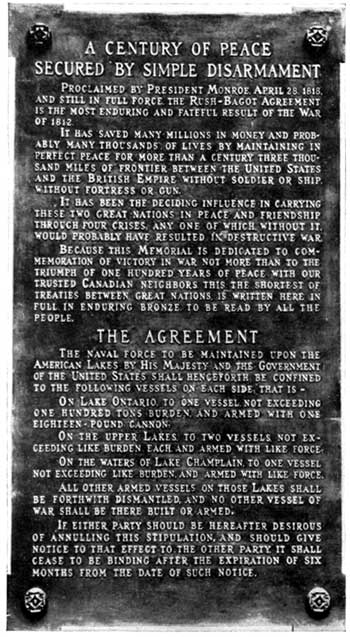 Bronze tablet on memorial shaft at Put in Bay. |
On land, the American military operations left much to be desired. At the end of the first year of war, Wellington remarked that the American campaign against Canada was "beneath criticism." Military unpreparedness and negligence reaped their just reward in August 1814, when the British moved on Washington. Five miles northeast of the capital, the American militia retreated in such a panic that the event was humorously referred to as the "Bladensburg Races." Shortly afterwards, Washington was captured and partly burned by the British in retaliation for American destruction of public property at Newark and Toronto. The most important pitched battle was the Battle of New Orleans, fought 2 weeks after the British and American commissioners had signed a treaty of peace at Ghent, December 24, 1814. It already has been said that if modern systems of communication had existed, war might not have been declared by the United States. Similarly, if news of the Treaty of Ghent had been known, the greatest land battle of the war probably would not have been fought. Doubtless the most far reaching of all of the events on land were concerned with the Indians rather than the British. These were the defeat and death of the Indian chief Tecumseh in the battle of the Thames, October 5, 1813, and Jackson's decisive victory over the Creeks in the battle of Horseshoe Bend, November 9, 1813.
In English history, the War of 1812 with the United States is such a minor incident in the larger story of the British effort to crush Napoleon that the war in America is hardly mentioned in most English history books. The chief results, so far as the United States were concerned, were a diminution of the Indian menace and consequently a more rapid settlement of the West, the development of a new nationalism and a more vigorous national spirit, and finally the achievement of a certain degree of economic independence on the part of the United States as a result of the war and blockade which led to the development of the infant industries of New England.
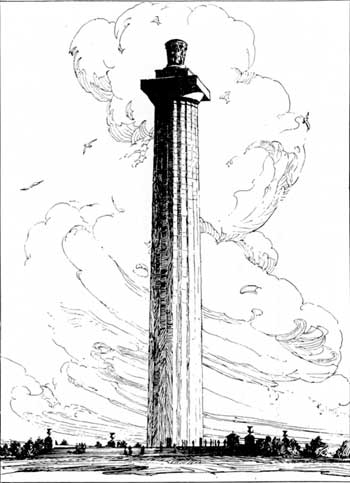 Commemorative shaft at Perry's Victory and International Peace Memorial National Monument, Put in Bay, Ohio. From a drawing by George N. Wallace. |
It often has been said by the more cynical historians and diplomats that a treaty of peace may be defined as "the foundation for the next war." The Treaty of Ghent, December 24, 1814, was a doubly remarkable document. Concerning the more important issues over which the war had been fought, the treaty had absolutely nothing to say; yet it was regarded at the time, and has been ever since, as one of the most popular peace treaties ever made. The war as a whole had not gone well for the United States and an honorable cessation of hostilities was a welcome relief, especially in consideration of the fact that Napoleon had just been exiled to Elba and it looked as though Britain would be free to send Wellington and his veterans to America. In these circumstances the people in the United States felt not unlike a college student body and football team that had fought hard all afternoon to stave off defeat and had at last been rewarded with a tie score. Then Napoleon came back from Elba, embroiled Europe in war again, and Britain thanked her lucky stars that Wellington and his veterans had not been sent to the Western Hemisphere.
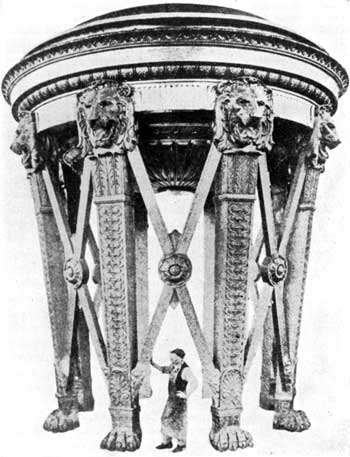 The 11-ton bronze urn, 23 feet high, is equipped with power electric lights which project a vertical beam. |
Shortly after the peace of Ghent, Great Britain and the United States perpetuated the prevailing spirit of good will and respect by coming to three agreements which consolidated the amity of the two nations. A commercial convention of 1815 provided for reciprocal trade between the United States and the British Isles and between the United States and the British East Indian possessions, though trade with the British West Indies still was denied. An agreement of 1816 provided for the disarmament of the Great Lakes, and the Convention of 1818 made regulations for American participation in the Labrador fisheries, ran the Canadian boundary from the Lake of the Woods along the 49° latitude to the Rocky Mountains, and provided that the Oregon country should be held in joint occupation for 10 years. By treaty in 1846, the boundary along the forty-ninth parallel was extended to the Pacific. The end of the War of 1812 thus began a period of peace and friendship which has existed for more than 120 years, although the Canadian-American border is, for more than half of its distance, only a line on a map. It is therefore quite fitting that this remarkable record of international concord should be signalized by a peace memorial on one of the Great Lakes, close to the imaginary line separating the United States and Canada. The lakes separate and at the same time unite the two peoples, and their unfortified and disarmed condition is an everpresent reminder of Canadian-American success in the maintenance of peace without warlike preparations.
It remains to be explained how a "Victory Memorial" also can be a "Peace Memorial." At first, one might be led to think that celebration of the success of American arms would excite ill-feeling in the hearts of our friends on the other side of the Canadian-American border. It is a noteworthy fact, however, that though Americans might burn British property and the British destroy American goods in the War of 1812, the conflict gave rise not so much to bitterness as to a wholesome mutual respect on the part of the two peoples for the fighting ability of each other on the seas. After the battle between the Chesapeake and the Shannon, the British gave the gallant Lawrence and his dead compatriots all the honors and homage that one side could give to the other. The battle flag of the Chesapeake has an honored niche in the Royal United Service Institution museum in London. Similar places of honor have been given to captured British flags now kept in the United States Naval Academy at Annapolis. Capt. Samuel Blyth of the British brig-of-war Boxer and Capt. William Burrows of the American brig-of-war Enterprise, killed in battle with each other September 5, 1813, are buried side by side in similar tombs at Portland, Maine, Similarly, three United States and three British naval officers, killed in the Battle of Lake Erie, are buried beside each other under a slab in the base of the peace memorial at Put in Bay.
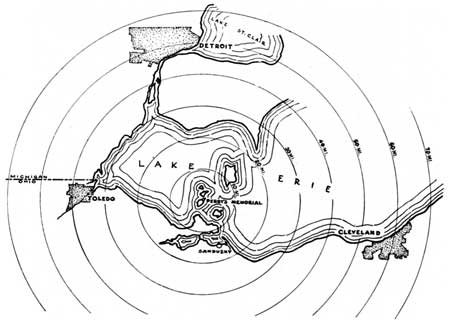 Map of monument area and environs. |
The story of the Battle of Lake Erie and of Perry's victory is a stirring one. The enemy fleet blockading Perry at Erie was led by Comdr. Robert H. Barclay. The latter relaxed his blockade for a moment and during August 2-4, 1813, Perry crossed Erie bar and took to the lake. He returned to Erie on August 10 and was reinforced by Master Comdt. Jesse D. Elliott with 102 men. On August 12, the fleet sailed up the lake without being opposed by Barclay who had retired to a station on the Detroit River. Perry then made Put in Bay his headquarters in order that he might watch Barclay and yet be convenient to Gen. W. H. Harrison, commander-in-chief of the western U. S. Army with headquarters at Seneca-town.
On September 9, Barclay sailed out to confront him, and the two fleets met the next day about sunrise. Perry had nine small vessels, the largest of which were the sister brigs, Lawrence and Niagara, of 480 tons burden each. The British commander's fleet consisted of the Detroit, the Queen Charlotte, and four other small vessels. In point of armament Perry had a decided superiority; but the number of effective men was about the same. As Perry planned the battle, his flagship Lawrence was to fight the Detroit, flagship of the enemy; the Niagara, under Commandant Jesse D. Elliott, was to fight the Queen Charlotte and the smaller United States vessels were to contest with the smaller British ships. At 10 a. m. Perry raised the battle flag of the Lawrence upon which had been inscribed Captain Lawrence's memorable words, "Don't give up the ship." In the battle which began at 11:45 and lasted until 3 p. m., the Lawrence bore the brunt of the fight, Perry having thrown caution to the winds and engaged the enemy at close quarters. The Niagara, which should have supported him, hung back, either on account of a lack of wind to fill her sails or because Elliott preferred to take advantage of his two long-range guns which enabled him to pound the enemy at a safe distance. Toward the end of the furious struggle, Perry found the Lawrence unfit for further action and transferred to the Niagara which had at length come up. In another 15 minutes the fight was over. Barclay surrendered his entire fleet, having lost 41 killed and 94 wounded. Perry, the only American naval officer ever to capture a British fleet, lost 27 killed and had 96 wounded. More than two-thirds of the American casualties were on the Lawrence.
Perry had lived up to his middle name. He had staked all on a sudden, close-in offensive and had won a decisive victory. The United States forces gained control of Lake Erie and retained it to the close of the war. This enabled Harrison to cross the lake and invade Canada. Perry's famous message, "We have met the enemy and they are ours," was addressed to General Harrison. Control of the lake enabled the United States diplomats to make good their claim to the Northwest in the peace negotiations at Ghent.
The Perry Victory and International Peace Memorial at Put in Bay, Ohio, consists of 14.25 acres attractively located on the northerly side of South Bass Island, one of a group of islands extending southward across Lake Erie from Point Pelee. The monument was constructed under the direction of the Perry's Victory Centennial Commission, between October 1912, and June 1915, at a cost of approximately $1,000,000, of which the United States contributed $250,000. It is of pink Milford granite and consists of a gigantic Doric column 300 feet high, the cap of which serves as an observation platform and resting place for a small penthouse surmounted by a bronze reflector 20 feet wide and 23 feet high and weighing 11 tons. The total height of the monument is 352 feet. The reflector is fitted with powerful electric lights that throw a beam straight upward. There is a plaza of 154 feet by 159 feet at the base of the monument and a lower plaza, 75 feet wide and 183 feet long. The column is, of course, hollow and is fitted with both stairs and elevator. Entrance to the column and to the rotunda of the memorial is gained by four doors marking the diameters of the column and facing the cardinal points of the compass. There are 467 steps in the stairway, which represent quite an exhausting climb, but the elevator ascends in 1 minute. The observation platform, or parapet, is designed to accommodate 300 people at one time. The scene from this point is one of great beauty and on a clear day it affords a view of the spot, 6 miles due west, on which Perry won his great victory, September 10, 1813.
The reservation of 14.25 acres and the memorial were ceded to the United States by act of the Ohio Legislature in 1913 and accepted by act of Congress approved March 3, 1919. Act of Congress, June 2, 1936 (Public, 631, 74th Cong.), provided for the creation of the Perry's Victory and International Peace Memorial National Monument by Presidential proclamation. The act and proclamation provide for the administration, protection, and development of the national monument by the National Park Service and for a board of advisers referred to as the Perry's Victory and International Peace Memorial Commission.
*From The Regional Review (National Park Service, Region One, Richmond, Va.), Vol. 1, No. 4, October 1938, pp. 2-5.

|
|

|
|
|
Last Modified: Sat, Oct 20 2001 10:00:00 am PDT |