|
|
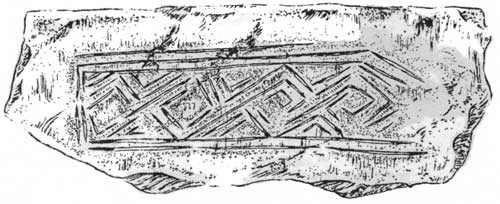
Stone houses of horizontal masonry have been in use in the Southwest for over one thousand years. Their evolution, from crude shelters of a few rooms, to the complex structures of the Classical Period of Pueblo III, is gradually being traced. Each of the contemporaneous groups, throughout the region, developed characteristics in construction that permit its recognition, and differentiation from each other. The Mesa Verde masonry composed of large individual stones carefully laid up, exhibits a characteristic pecked or stippled surface. It differs in this respect from that of the Chaco or Kayenta districts. This masonry, of the "Green Tableland," possesses an additional feature which has not been reported from other prehistoric structures of the Southwest. The practice of using decorated building blocks, containing pottery designs, is confined to the Cliff Dwellers of this mesa. Etchings or paintings on rocks in North America are distributed generally. They differ markedly in character and significance. The record of incised conventional geometric designs carried over on to masonry from pottery is a local custom only. An examination of the many petroglyphs located on cliff and cave wall over the Mesa Verde, fails to reveal this practice excepting in the actual building blocks. Fewkes1 first makes mention of the incised pottery design occuring on a slab of stone found in Cliff Palace. This meander, which is reproduced in Figure 1, occurs on many pots in this region.
In excavating Far View House Ruin in 1916, Fewkes2 again uncovered a series of building blocks, containing pottery designs, which at one time had their place in the walls of the building.
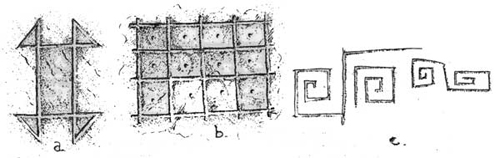
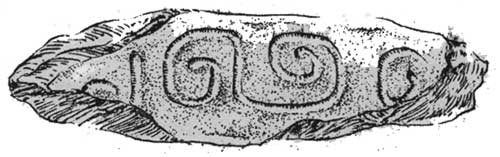
Figure "a" may be considered one of the conventional pottery designs found on the exterior of Mesa Verde Bowls. One such bowl is on display in the park museum. In "b", the checker-board with center dot, we have a decoration that seems almost characteristic of the Chaco Canyon culture, but a study of the sherds in the Mesa Verde museum revealed its use by the Cliff Dweller. Spinden3 notes a very interesting development of this design as coming from the arrangement of the corn kernels on the cob. The scroll and reverse represented in "c" is a prevailing decoration on both the black-on-white ware and on the indented vessels. In one of the exhibit cases of the Park Museum is a beautiful specimen of the scroll incised carving. The ruin from which this rock was taken is unknown at this time, the the character of the decoration is truly Cliff Dweller.
The many rocks, containing Cliff Dweller pottery decorations, found in Sun Temple is almost ample proof that this much discussed structure belongs to the great Cliff House culture.
As a rule the designs are geometric and much like those on painted pottery in other Mesa Verde Ruins. Doctor Fewkes4 located some among the debris, of broken down walls and others still in place in standing walls. The latter are left in situ, but those found scattered about the ruin were set up in cement, available to the visitors inspection.
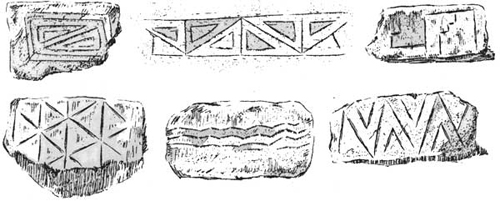
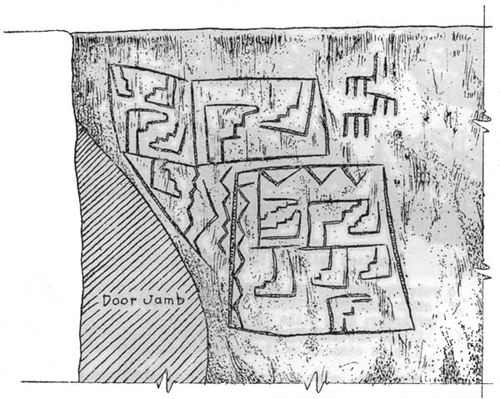
Spruce Tree Ruin, many times carefully examined and excavated, gave up one of its carefully guarded secrets this past winter. In taking measurements of the ruin a quantity or rat excrement was removed from the sill of a "T"-shaped doorway, and a most interesting series of pottery designs was found incised underneath. Pictured as they are in Figure 5, it would appear as though the maker was attempting to arrive at some orderly arrangement of the units before applying them elsewhere.
The importance of these incised designs on stones in the walls of the Cliff Dweller's structures should not be under-rated. Found in other dwellings besides those mentioned in this article, it is a characteristic that acts as a trade mark in the masonry. From the arrangements, of the incised rocks in the walls, some high some low, it appears that the decoration was placed upon the building stone before it was set in the wall. It is possible that this custom represents or indicates an advance in architectural decoration not found in other prehistoric buildings in the Southwest. They may be considered as first steps in the development of mural sculpture. -oOo- | ||||||
| <<< Previous | > Cover < | Next >>> |
vol3-3b.htm
14-Oct-2011