|
|
On exhibition in various museums and private collections one may see pottery, weapons, and other artifacts taken from the ancient ruins in the Southwest. Such display sometimes creates the impression that an archaeologist is a collector whose chief object in excavating is to gather as many odd specimens as possible. If that were true, all the time and money spent by expeditions in the field would be largely wasted. Actually, the collection of specimens is only a part of the work. The real purpose in doing archaeological work is to determine the time and influence of an ancient civilization in the history of man. That has been the problem of Nordenskiold, Fewkes, Nusbaum, and others who have done archaeological work in the cliff ruins of Mesa Verde. In defining a civilization it is desirable to know several things about it; the geographical location and environment, the racial group to which its people belong, the language they spoke, the material culture of the group, their customs and finally, the dates during which their civilization existed. At first sight it seems an utter impossibility to obtain all this information about the Mesa Verde people. They left no written records and had no calendar system that can be interpreted today. However, very complete information has been obtained by other methods used by archaeologists. In many cases they have been aided by specialists in related sciences. In determining the environment of the Cliff Dwellers it has been necessary to consult geologists, botanists, and zoologists. It is the opinion of geologists that the physical features of the Mesa—the canons, caves, and cliffs—have not undergone any marked change during the history of man. When the Indians lived here the mesa had the same appearance it has today. An identification of plants used by the Cliff Dwellers shows that the vegetation at that time was no different from that of today. The Cliff Dwellers used the juniper, pinon pine, yellow pine, and the Douglas fir in building roofs in the dwellings. From various shrubs—mountain mahogany, serviceberry, mock orange, and others—they fashioned planting implements, prayer sticks, and other articles. The yucca, fruit, prickly pear, pinon nut, and mariposa lily bulb were used for food. In a similar way, an examination of burned animal bones found in the ruins indicates that the animal life has not changed, except that the mountain sheep and antelope are gone from this region today. The width of tree rings in beams from the ruins corresponds to the average width of rings in living trees. Therefore it is safe to say that the amount rainfall and extremes of temperature are the same in both cases. Finally, the experimental growing of corn on the mesa for the past six years proves that the soil is fertile and the precipitation sufficient for the growing of crops. Good quality corn has been raised without irrigation or fertilization of the soil. The Cliff Dwellers were American Indians. The skeletons show resemblances to the Mongoloid race, as do other Indian tribes. They have been classified, further, with the Pueblo group of Indians, for all the skulls are broad, with the back artificially flattened. Their language has not been determined. They left no writing, nor any hieroglyphs that might be deciphered. Neither is it certain that they spoke one of the languages of the present day Pueblo Indians for the descendents of the Cliff Dwellers cannot be directly traced to any one of the living tribes. There has been no difficulty in finding evidence of the material culture of the Mesa Verde people. The ruined dwellings and the artifacts found in them tell the story completely. The houses were of stone with terraced rooms. In the courtyards or plazas were kivas, all of one type of construction characteristic of ruins of Southwestern Colorado. Their staple food supply was corn, but they also cultivated squashes, and gathered wild nuts and berries. Clothing was made from fiber or skins. Sandals and other coarsely woven fabrics were made from yucca leaves. The stone ax and the bow and arrow were their weapons. The ceramic art was highly developed. Their decorated ware, unique in structure and design, is found only in the region of the Mesa Verde. No exact knowledge of their customs, family life, and social organization is available. However, much can be inferred from a a study of the living Pueblo Indians, whose material culture is like that of the Cliff Dwellers. For example it is probable that the Cliff Dweller society was matrilinear, that is, descent was through the mother's side of the family. Undoubtedly their creation myth involved a belief in four successive worlds through which they ascended. This belief is a part of all creation myths among modern Pueblos. Their religion and ceremonies centered around the kiva, and their principal ceremony was for the production of corn. Doubtless, too, they had several migration legends, explaining their arrival in this section. Fortunately, these have not survived to confuze the archaeologists. Definite information is available on the dates of the Mesa Verde civilization. Doctor Douglass has dated a number of beams from the ruins. At present the inclusive dates are 1073 to 1262 A.D. Further work on beam dating now in progress will give more complete information on the inclusive dates of habitation. This archaeological work has been carried on since 1891, and meanwhile, others have been doing similar work among ruins in other areas in the Southwest. Various reports have been published, and as a result a vast amount of data was accumulated. In recent years careful study has been given to all the published material, to bring some order out of the mass of facts. For this purpose two methods have been most useful—comparisons of the various cultures, and stratigraphic evidence.
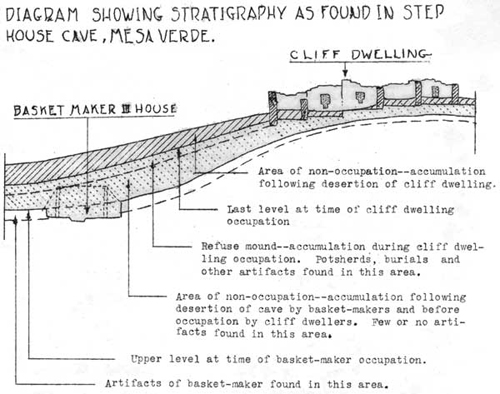
By the first method, a careful comparison of ruins and artifacts, it has been determined that all the great pueblos are of one period—The Classic Pueblo era. Mesa Verde's great Cliff House culture is in this group. Altogether there were ten centers of high development; Mesa Verde, Chaco Canyon, Kayenta, and seven others to the south in New Mexico and Arizona. All had elements in common; terraced houses, subterranean kivas, beautiful decorations on pottery, agriculture, considerable comfort and leisure fer individuals, and a complex social organization. By use of the second method, stratigraphic evidence, more valuable information has been obtained than by any other means. The basis for stratigraphy is clear, when the remains of one civilization are found beneath those of another, in undisturbed localities, it is certain that the lower one is earlier. Many instances of this have been found in the Southwest, where such remains are well preserved. In other instances, a number of different cultures have been found, one above another. By using this evidence, scientists have established the chronology of the different civilizations, and reconstructed the history of the Indians in this region. The archeologists distinguish three periods of Basketmaker occupation, terminated by the coming of the Pueblo people. This took place about the beginning of the Christean era, and the Pueblos have occupied the region since. Their history is divided into five periods. The first two were the forerunners of the classic period, which flourished from 900 to 1300 A.D. After it came two more, the historic Pueblos and those of the present day, both representing a degeneration of the great period. More extensive archaeological work is being done in the Southwest now than ever before. It is being done more carefully, as well, with the result that the history as outlined is constantly being supplemented with new facts. It is interesting to note that none of the latest evidence contradicts this outline of cultures based on stratigraphic evidence. -oOo- | ||||||
| <<< Previous | > Cover < | Next >>> |
vol3-3c.htm
14-Oct-2011