|
|
The keynote of the small museum in the National Parks is public service. Its purpose is to give pleasure and at the same time to impart knowledge. The methods used in imparting this knowledge must necessarily vary with the locality of the museum and with differences in materials to be displayed. The technique used by museums is the display of a variety of objects through which, by visual presentation, instruction is given, and the success achieved can only be measured by public reaction. Years of experimentation are necessary and the ideal permanent exhibit is never achieved. The behavior of the museum visitor, so well studied by Robinson1 is the criteria by which the museum staff should judge the effectiveness of their display.
The materials collected are usually worthy of careful study and of great interest to scientists. But the general public visiting the National Parks wants recreation, usually they are on a vacation, and will accept its education only so far as it is recreational and not boring. Thus a balance must be created for the scholar that comes to study your collection and the visitor that will be "exposed" to your educational activity. A careful check and study of the visitors to the Mesa Verde Museum has shown the need for changing the exhibit material from time to time. These changes are particularly valuable in retaining the interest of visitors who return. In the early 1932 issue of Mesa Verde Notes2 a description was given of the changes and additions to the museum as a result of that writer's work. Though the additions for this season are not as numerous as last year's, they are of more importance.
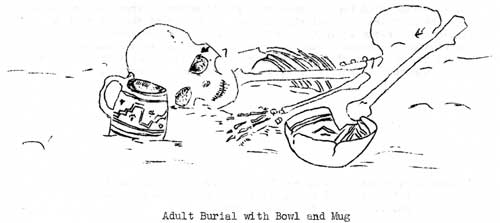
New Displays The most noteworthy addition to the Cliff Dweller exhibits is a newly found burial. This skeleton placed in an earth filled flat box shows a normal adult individual in the typical position in which most Mesa Verde burials are found. With this exhibit we hope to correct the impression that the Mesa Verde Cliff Dweller was of abnormally small stature. The skeleton is in the flexed position, with the arms and knees drawn against the chest, a bowl and mug rest alongside. The bowl was badly broken and several pieces are missing. The mug was unbroken and is a very worthwhile addition to our collection. This mug of typical Mesa Verde black-on-white ware is 7-1/2 cm. in diameter at the lip and 10 cm. in diameter at the base, with a height of 9-1/2 cm. It is decorated with terrace or step design as shown in the sketch. A bird's head has been fashioned on top of the handle and this is the first of such effigy mugs in the museum collection.
Miniature Habitat Groups. Under construction at the present time is a series of miniature habitat groups, each about four feet by five feet with a depth of four feet. Through these sets the museum staff aims to present more clearly to the public the story of the prehistoric cultures of the Southwest. One such set has been completed and it illustrates the early Basket Maker culture. A large cave has been peopled with finely modelled wax figures in attitudes of daily task processes. Thus, the weapons, ornaments, the baskets, and the methods of storing and preparing food along with the place of habitation can all be determined by the careful observer. This set framed in a wall niche and flooded by hidden artificial light presents a picture and story that will be long remembered. Many visitors remark about the naturalism of the group and one often hears a conversation such as this: "Can't you just see the people, the real inhabitants of these homesites going about their daily tasks, living as they actually did hundreds of years ago?" Many can visualize such habitations without actually seeing them. The picture is made up of impressions they have gleaned by hearsay and by examining museum effects. By this miniature reproduction we have concretely expressed what many people see mentally, thus helping some to visualize more extensively and guiding ether more fertile minds along correct channels, for all the construction has followed carefully data collected by archaeologists.
The scene reproduced is during the time of harvest and storage for winter. The women are busy with the corn, one bringing in the husked ears in a basket, another placing it in a storage cyst, a child mending a basket, a mother grinding the corn to meal with metate and mano, an old man bringing in fagots. In the central foreground stands a commanding figure of a warrior, demonstrating his skill with the atlatl; a beautiful figure, proud and strong. He has about him a small group of admirers, apprentices, younger men and boys who aspire to his accomplishments. As you look at each and every figure and at all the material in the cave you are satisfied and say to yourself—yes, it was like that. Subsequent sets will show the late Basket Maker culture, who are the first of the pottery makers, and then the Cliff Dwellers, the builders of the big stone houses. It is in the latter set that probably the most spectacular setting will be achieved. To reconstruct a cliff ruin of several hundred rooms, to repeople the cave, and so help visitors to actually see what these cliff homes looked like eight hundred years ago is the aim of the museum staff. -oOo-
| ||||||
| <<< Previous | > Cover < | Next >>> |
vol4-1b.htm
14-Oct-2011