|
|
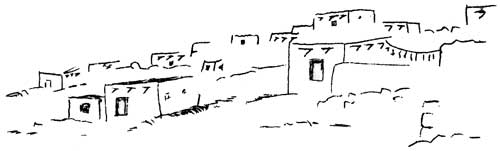
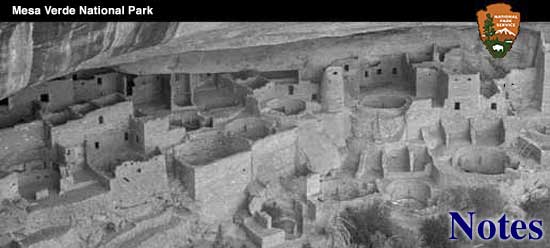
Colorado is placed at a strategic position for the study of Indian cultures. In the southwest corner of the state is located Mesa Verde National Park, the classical district so rich in archaeological remains of the famous Pueblo culture and representing the Upper San Juan basin in the vast Southwest area. In the region west of the Front Range of the Rocky Mountains, in the picturesque country of lofty peaks, sheltered parks and high plateaus, lived the Utes and kindred tribes, the trapper variety of the nomadic-hunting culture. Relatively little is known of the aboriginal life of the people. On the rolling prairie extending over the eastern half of Colorado roamed several warlike tribes: Arapaho, Cheyenne, Kiowa, and Comanche. The ethnologist has studied them, the historian has recorded their exploits, the artist has glorified them in painting and statuary, not to speak of the poet and novelist. But the archaeological remains, much less conspicuous and spectacular than those of the Cliff-Dwellers, had been entirely neglected until a few years ago. It is thanks to the various expeditions sent out to explore the High Western Plains by the University of Denver, assisted by the Smithsonian Institution and the Colorado Museum of Natural History, that several hundred prehistoric and protohistoric sites have been recorded. The study of the stone implements collected by us on the old camp sites, work shops, quarries, look outs, and blow outs, revealed an astonishing resemblance with stone artifacts of the Old and the New Stone Ages of Europe: same shapes, same techniques, for probably identical needs and similar degrees of culture. A primitive type of pottery was also found at many sites where previously it was unknown. Many Colorado pictographs recalled some seen in Spain. However, the Pueblo culture of Mesa Verde and surrounding country south of the San Juan Mountains was without doubt the highest in Colorado. I say Pueblo, because there is no distinct Cliff-Dwelling culture. A Cliff-Dwelling is nothing but a Pueblo built in a natural cave or cliff shelter for the purpose of protection. Otherwise we have the some people enjoying the same culture during the same period, whether in valley or mesa pueblos or in cliff-dwellings. Besides, I advisedly said culture, because to deserve the qualification of civilization, a culture must show evidence of a practical knowledge of the means of recording ideas or facts, by way of some sort of written language and finally the government organization must reach beyond the narrow limits of the village and represent at least a small nation with centralized authority. And we know that in Pre-Columbian times, north of the Rio Grande, no Indian culture qualified according to these criteria. The natives, whether Pueblos, Plains Indians, Mound Builders, or ethers, were all still living in the Stone Age, although some enjoyed an advanced stage of culture. Moreover, all those aborigines, regardless of time or place were Indians. There is no such person as a pre-Indian: Indian is merely a geographic term similar to European, African, and Asian. It has nothing to do with culture, language or race. All aborigines, whether Folsom-man, Basket Maker, Pueblo, Mound Builder, Aztec, Maya, or Peruvian, agriculturist, hunter, fisherman, or digger, all were Indians because natives of the American continent. Among the Indians, according to periods and parts of the country, various physical types were encountered as is natural to expect anywhere in the world. This was true for Colorado as it was and still is true for the Southwest. Besides the variety of physical or racial types, of languages and of cultures in prehistoric America, one must recognize the progressive evolution from the modest cultural beginnings of the Early Basket Makers, to the highest achievements of the Cliff-Dwellers of Mesa Verde over a period of three millennia or more. There again a fair degree of similarity is found if one observes the cultural development of Europe and America. The first hunters of Colorado and the Southwest lived in a paleolithic stage of culture, leading a parasitic existence, hunting game, collecting wild roots, berries, and nuts, making artifacts of flaked stone, but ignorant of the bow and arrow, of pottery, of agriculture and sedentary life. Then the so-called Basket Makers started cultivating maize or Indian Corn, developed fine basketry and even weaving, became progressively stabilized, dug cists for granaries and later habitation in rock shelters, and came to build small and deep pit-dwellings in the open. They also invented pottery. Their principal weapon had been a dart-thrower such as also was known in the European stone age and they finally acquired the bow and arrow, probably from incoming tribes. We recognize during that interesting period many traits found in the Mesolithic or Middle Stone Age of Western Europe. Then we witness the Pueblos, new comers in the Southwest, taking over the Basket Maker culture, mixing with old people, in part absorbing them, developing their early inventions, improving their agriculture, perfecting their pottery, and becoming master masons. This is an evolution somewhat parallel to that of the Danubian peasants during the Neolithic or New Stone Age. We recognize similar small and deep pit-houses, circular or rectangular; later they become more shallow and finally they are built on the surface of the soil and comprise several chambers. At the beginning mud and poles were used, but the Pueblos learned true masonry sooner than the Central Europeans. These, to take care of the snow and rain of their country had double slanting roofs, while in the dry climate of our southwest a flat roof was sufficient such as seen in North Africa for the same reason. The dryness of the region led the ancient Pueblos to develop irrigation and incessantly to pray for rain which was not necessary in the well watered valleys of the Danube and the Rhine. Whereas our Indians cultivated maize with a hoe, the Danubian farmers of the same stage of culture growing wheat and barley used the plow and sickle. But the grinding stones of the Neolithic period, be it in Egypt or in New Mexico, were astonishingly alike. The ceramics of Europe, outside of the Mediterranean countries, during the New Stone Age, was more like that of the plains or the mounds. The principal modes of decoration were tooling the clay by incisions, grooving, imprinting of cords, etc., painting being relatively limited. On the contrary the Pueblos have been known for centuries to be great artists in painted pottery and are to this day. And so we could continue the comparison, elaborate on some points, but essentially the cultural substratum of the Pueblo-Cliff Dweller people of the Mesa Verde and the Southwest was similar to that of the European peasants of the New Stone Age. They both had become food producers, they were agriculturists, and sedentary people living in villages, either open and peaceful communities in the valleys or fortified sites on the hill slopes as in Central Europe or in the canon side caves as in the Mesa Verde. The Danubians were favored with the possession of sheep, goat, swine, cattle, and later the horse, the Pueblo handicapped by the scarcity of domesticable animals had only the turkey. On the other hand we have seen them to be better masons and potters. In concluding, one point must be emphasized. The Europeans progressed more rapidly because they were in touch with more advanced civilizations and new inventions were brought in from Asia and elsewhere. While the Indian, entirely isolated, remained in the Stone Age until the coming of the White man, but what he invented. and developed was really the product of his own genius. -oOo- | ||||||
| <<< Previous | > Cover < | Next >>> |
vol4-1c.htm
14-Oct-2011