|
|
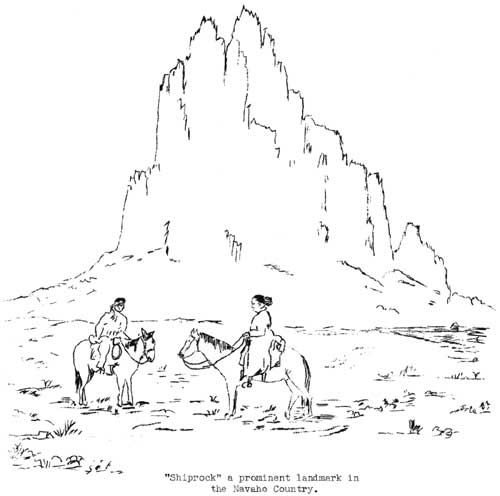
Upon entering Navaho Land for the first time the traveler often expresses surprise that out of this seemingly barren and inhospitable country comes the finest example of aboriginal art and industry, the Navaho blanket. The birthplace of these interesting products of the Indian loom is, indeed, a strange land and many and varied are the impressions it leaves in the minds of the people who cross it. Often impressions are bad for most travelers see the Navaho country in the summer when it is not always at its best. Parched earth, dancing heat waves, perhaps a dry radiator and no water for miles. The vicious sting of the sandstorm, the sudden breaking of a torrential cloudburst. Dangerous moods, indeed, but there are others far different. Gentle moods, beautiful moods, and to know them all one must linger long enough to see all of Navaho Land during each of the seasons of the year.
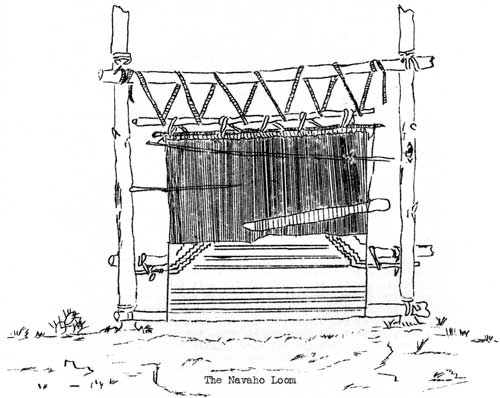
It is a land of marvelous beauty, a land of fascinating wonders. The drab, sage-covered desert gives way here and there to high, tree-covered mountains, where turquoise lakes send silvery streams cascading down to the parched desert below. Great mesas rise hundreds of feet above the floor of the desert, their beetling cliffs banded with colors of every hue. In many places the mesas have been so gnawed away by the ravaging storms of the centuries that now only fingery pinnacles and monuments remain. In other places the desert opens and yawning canyons appear, deeply gouged wrinkles in the face of the earth. In great caves in the sidewalls of the canyons are the Cliff-Dwellings where, according to Navaho mythology, live the Yeis, the Gods of Navaho Land. At still another place the desert gives way to the most miraculous bit of coloring to be found on the face of the earth, the Painted Desert, where Mother Nature, in a delirious moment, mixed together all the colors on her palette and with lavish strokes applied them to the earth. Color! Color! Color! Navaho Land cannot be equaled for the parade of color which it flaunts. It cannot be equaled for the diversity of its natural wonders. And surely it cannot be equaled for the interesting qualities of the people who inhabit it. In the very midst of this strange and beautiful land live the Navahos. For centuries they have lived here; even they do not know how long. For countless generations their lives have been dictated by the moods of their homeland. Day after day, year after year, they have reacted to the whims and fancies of this land until now they seem to be animated bits of earth itself; bits of earth, quickened with human life, but still impelled by the forces of nature. With such a heritage it is small wonder that the Navaho weaver can put the very essence of the land into her blanket. Notice it there on the loom, supported by two sturdy poles planted in the earth. It seems part of the earth itself and one can almost imagine that it has come into existence, not as a product of human hands but as a weirdly beautiful plant that has sprung from a seed dropped by one of the Gods. All plants, the Navahos say, grow from seeds planted by the Gods. In the winter when fog lies close to the ground the Indians know that the Gods are busy with their planting, and are using the fog as a screen against human eyes. Perhaps one of the Gods, in a capricious moment, snatched bits of color from the earth and from the sky, compressed them into a seed and planted it here, and from this seed has sprung this beautiful plant we call the Navaho blanket. But no, the Gods had no hand in it. It is the work of the Navaho squaw. Many centuries ago a squaw learned the art of weaving from the Spider Woman. Down through the centuries it has come, mother to daughter, daughter to granddaughter, and now, as a result of this heritage, each squaw is able, in her turn, to weave all the beauty and color of her homeland into her blanket. All of the glory of the land has been transmitted to this thing of beauty through the fertile mind and nimble fingers of the Indian woman.
Truly typical of the region, and surely typical of the Navahos, the blankets are the finest souvenirs that can be acquired on a trip through the Southwest. Everywhere they will be encountered. Thousands of them are on display and the prospective purchaser is often bewildered in his attempts to make a choice. Thousands of blankets, but no two alike, differing in color, weave, design, and texture. Natural colors, native dyes, commercial dyes, factory dyed yarn, old designs, modern designs, oriental designs, typical Navaho designs, zoomorphic designs, lard pail designs, fine weaves, coarse weaves, cotton warp, wool warp, and so they go. Certainly a bewildering array, and the person picking blindly often regrets his choice. To really know the Navaho blanket one must study it thoroughly and true knowledge comes only after years of handling blankets of every type. This knowledge is, of course, denied most people but there are a few simple rules that will help even the novice in making selection. By following these rules one should be able to get a better blanket for the money than if the selection is made merely on appearances. Cotton Warp Although the traders have almost won their fight against the cotton warp, a blanket with this inferior warp is occasionally woven. Instead of spinning her own warp yarn the weaver has used ordinary cotton twine or yarn and in this way saved herself a great deal of work. In an ordinary four by six blanket there are fourteen hundred feet of warp yarn, and the substitution of the ready made material saves many days of tedious labor. To the casual observer the cotton warp is not evident and in no way affects the appearance of the blanket, but it does affect the wearing qualities, for it is weak and cannot stand the strain of rough usage. Usually the dealer's word can be relied upon, but if the buyer wishes to examine the warp it is not difficult. If the blanket is not too tightly woven the weft threads can be spread apart with the fingernails and the warp threads brought into view. Or again, short sections of the warp threads may be seen at the ends of the blanket where they loop around the last weft threads. Note the appearance of these threads. If they are very smooth and even and not very tightly twisted, and each thread is made up of several smaller threads twisted together and look like ordinary twine string, shy away from it. It is surely cotton. But if they are somewhat rough and uneven, and very tightly twisted, and are not made up of several small threads, they are of wool. Usually they are gray or white in color and their handmade character is evident. Design The first thing about a Navaho blanket that strikes the observer is the design and not a great deal can be said about this that will help the prospective buyer. Every blanket is different, and what one person considers attractive another will consider atrocious. Some designs, however, are more typical of the Navahos and are more desirable. In the old blankets the designs were not as spectacular as those encountered in most of the modern blankets. In the old ones we find simple stripes and bands of color running across the blankets, or bits of color worked in, in the form of small squares, crosses, diamonds, and zigzag lines. There were no borders in the early blankets, this being an oriental idea the Navaho has borrowed from the White man. A great effort is being made to induce the weavers to go back to the old designs. Pictures of the old blankets were given to the traders all over the reservation and these the traders showed to the weavers, urging them to make copies. Many of the weavers have responded, and it is now possible to buy very good copies of some of the fine old blankets. Many people prefer blankets with borders, and feel that there is a greater wealth of design in the more modern patterns. This is in a way true, for the modern weaver uses many more design elements in her blanket, and if she has not used them so haphazardly as to make a confusing pattern her blanket will compare very well in attractiveness with the older blankets. Stars, feathers, arrows, corn plants, and figures of animals and men are now encountered in blankets. although the two latter elements are not as typical of the Navahos as are the others. Blankets showing trains, automobiles, coffee cans, lard pails, peoples names, and such modern things scarcely deserve to be called Navaho blankets. The "Yei" blanket is perhaps an exception to the statement that blankets containing figures of men are not typically Navaho. The Yeis are the Navaho Gods, and many blankets are appearing with their pictures. When they first appeared they were considered quite unusual and were very valuable. They are so common now and so many are poorly made that few of them are any more valuable than the ordinary blanket. Quite often exorbitant prices are asked for them. A comparatively recent development is the Sandpainting blanket. These blankets carry pictures of some of the famous Sandpaintings made by the medicine men during their ceremonies. Most of them are not exact reproductions for the Sandpaintings are destroyed after a few hours and the weaver must reproduce them from memory as best she can. Notable exceptions to this are the Sandpainting blankets of Tla, a famous old medicine man, who, knowing the Sandpaintings has woven in his blankets exact reproductions of them. His blankets are very large, and are said to be perfect in every detail. They bring fabulous prices and are snapped up by collectors. One thing should be mentioned before leaving the subject of design and too much emphasis cannot be placed on this point. Navaho blanket designs do not tell stories. There are still a few men who will, for a price, tell a beautiful story, which they claim, the weaver has worked into her blanket. All that need be said is that this is absolutely untrue. Tla's blankets are exceptions to this, in that the Sandpaintings do have a meaning to those able to read them. Color In the modern Navaho blankets no color seems to be barred and the prospective buyer will be able to find all of the colors he wants, and a great many he does not care for. Imagination cannot conjure up the picture that red, green, yellow, white, blue, purple, and lavender can make in a blanket, but in some parts of the reservation, where foolish traders are supplying the weavers with every color in the spectrum, such combinations can be found. The modern dyes, now widely used by the weavers, are so bright that they must be very carefully used or they will strike up discords that will shake the faith of even the staunchest friend of the Navahos. In the early days of blanket weaving many colors were used but the colors were so soft and well blended that the effect is very pleasing. In some of the old blankets in the Mesa Verde collection six and seven and even eight colors are to be found, but there is never a discordant note. The White Antelope blanket, which is on display at the Laboratory of Anthropology in Santa Fe, is considered to be the most beautiful blanket ever woven. I believe I would be safe in saying that this blanket contains easily fifty different shades of color. In a moment's time a dozen shades each of red, blue, green, and yellow can be counted, but no one would ever say that this blanket is too bright. The natural color blankets are popular with many, because in them are found only natural colors of the wool; white, black, brown, and grey. These colors in the hands of a skillful weaver, work into a very soft, harmonious pattern, and will not fade under any circumstances. The most famous of the natural color blankets come from the Two Gray Hills region. They are of a very fine tight weave, and the design, strikingly oriental in motif, is so perfect that it seems impossible that it came from the simple Navaho loom.
The favorite color of the Navahos is red and more or less of it will be found in the majority of their blankets. If carefully used it gives a touch of life to the blanket and to the room in which it is placed. The blues, yellows, purples, and greens produced by the modern commercial dyes are so brilliant that care must be exercised in selecting them. Often a blanket selected from a great pile of blankets does not seem too bright, but on getting it home by itself the owner finds that he has a screaming monstrosity on his hands. A new development in the way of dyes is the Du Pont dye which has recently been placed in the weaver's hands. These dyes are supposed to produce soft colors like those found in the old blankets. In a measure they have been successful and attractive blankets have resulted, but the process of using the dyes is so complicated that many of the weavers have not been able to get good results. The blue dye is especially difficult to use and in one blanket this color may range from light gray to deepest indigo. One trader, in an effort to sell these poorly dyed blankets expounded lengthily on the "new mottled blue which the Navahos have developed." 
At the same time that the Navahos were urged to go back to the old designs they were encouraged to go back to the old vegetable dyes. The weavers were reluctant, naturally, because the vegetable dyes were quite difficult to make. Sometimes the proper plants were hard to find or had to be brought from distant places, and it took many hours of tedious work to produce the dyes. On the other hand, it was a very simple matter to ride to the nearest trading post and purchase a fifteen cent package of dye. In some cases the traders were successful in their efforts and now there is on the market a limited number of these old design, vegetable dye blankets. They are certainly the most Navahoish of all the modern blankets and the finest come from the Chin Lee district in Arizona. Weave The most important thing about a blanket from the standpoint of value is the weave for it is this that determines the life of the blanket. A well woven blanket will wear indefinitely, while one that is poorly woven will soon be out of shape and unfit for use. The general rule is that the finer the yarn and the tighter it has been pounded down the better the blanket. Sometimes, though, a blanket made of larger yarn, not tightly pounded, will be soft and pliable and will be more desirable for a laprobe or bed cover, or for any use where a soft blanket is desired. The tightly pounded blankets are more serviceable and are better for use as rugs. Examine the warp yarn. (The warp threads are the hidden, lengthwise threads; the weft threads are the ones that carry the design.) The warp is the framework of the blanket and its quality determines the blanket's life. Does it seem strong enough to withstand the crushing force of heavy heels? Is it smooth and even and tightly twisted, or are there places where it is thin and loose? One weak place in the warp will cause an early break and the blanket will be doomed. Examine the weft threads in the same way. Be sure they are smooth and even and tightly twisted, and remember that the finer the weft yarn, the finer the blanket. Avoid a blanket that is full of lumps. If the weaver has not been careful enough to avoid lumps she probably has not been careful in washing and dyeing the wool. Be sure that the weft threads are well pounded together so that you can not spread them apart too easily with the fingernail. Some people use a pencil in this test. If the pencil can be thrust easily through the blanket it is too loosely woven, but if it resists this treatment it has been well pounded. Examine the entire blanket, for a tired weaver will sometimes become careless. Make sure that the tightness of the weave is uniform. After you have subjected the blankets to these simple tests and have found the one that seems to measure up best of all, do not hesitate to buy it, for it will give you many happy moments. In the warp and weft of this blanket you hold captive a bit of the color and charm of Navaho Land, the most colorful part of our country. The white of the east, the white light of early dawn, that is so important in Navaho mythology. The blue of the South, the eternal blue of the southern sky, the blue of the so highly prized turquoise. The yellow of the west, the summer sunsets of Navaho Land. The black badge of sorrow of the north, the land to which the spirits of the departed must journey, the land from whence come the stinging blasts of winter. Red, the symbol of happiness, the color of the sunshine, the blazing glory of the sunrise that begins each beautiful day, the flaming thunder of the sunset that brings it to a close. The brown of the desert, the shifting sands; the gray of the sage that clings to its bosom; the green of the spring, the color of new life. Color! Color! Color! All of the color of the land placed here through the inherent artistry of the Navaho weaver. Prize your blanket highly. Feel proud that you are able to carry away this thing of beauty that will not fade like a flower, but will grow more beautiful as the years soften its colors. Always it will bring to mind the glorious land from which it came, and the simple Indian woman, whose life is so shaped and directed by her homeland that some of its beauty and color has flown through her fingers into your Navaho blanket. -oOo- | ||||||
| <<< Previous | > Cover < | Next >>> |
vol4-1d.htm
14-Oct-2011