|
NEW FOREST FRONTIERS for: Jobs, Permanent Communities, A Stronger Nation |

|
Private-Land Problems
|
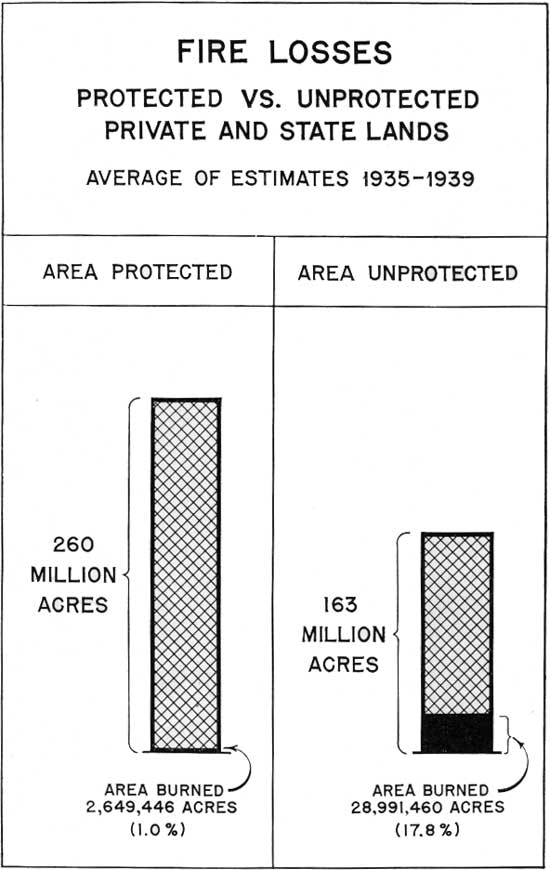
| THE SCOURGE of fire must be wiped out. During 1935-39, cooperative Federal, State, and private fire control was effective on 260 million acres of State and private land. The area burned was held to 1 percent. F-396954 |
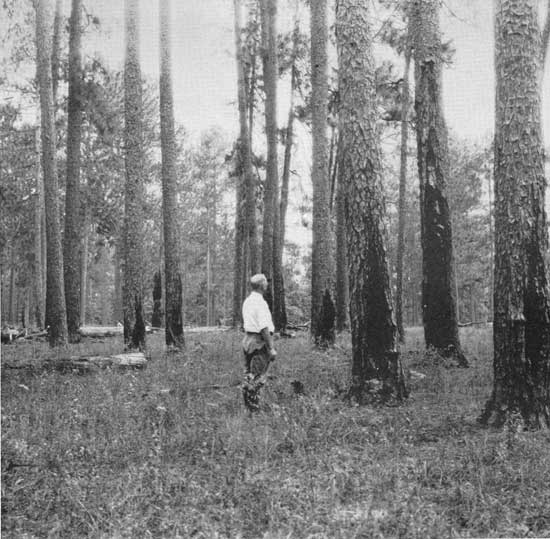 The best quality lumber is in the bottom logs. This most valuable portion in all of the trees shown has been degraded by repeated ground fires. Reproduction is entirely lacking for the same reason. |
| ONE HUNDRED AND SIXTY-THREE MILLION acres of private forest land were without protection, and fires burned over 17.8 per cent of this area. F-250494 |
|
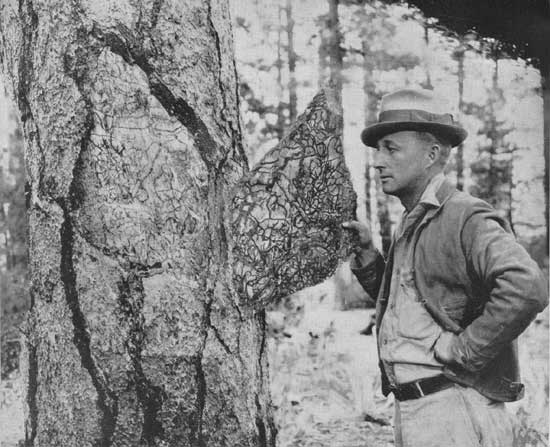
| THE RAVAGES of tree-killing insects must be controlled. Western pine beetles in Oregon and Washington killed nearly as much ponderosa pine as was cut from 1931-35. This was 15 times the amount destroyed by fire. F-285492 |
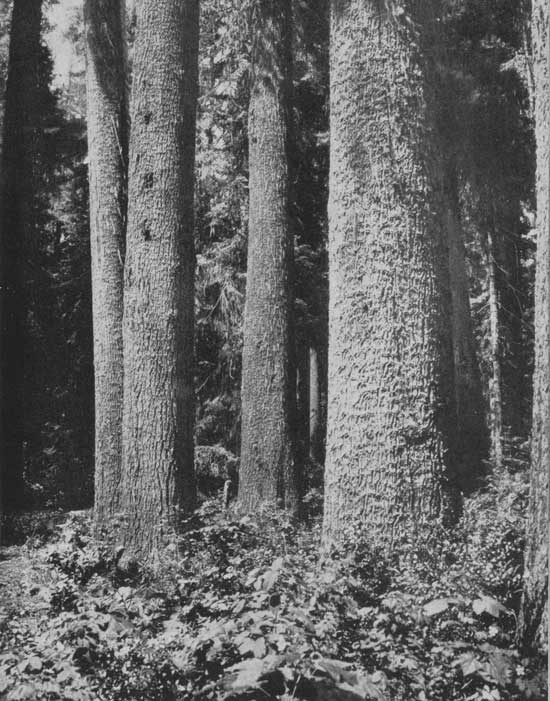 Mature white pine in Idaho. |
| FUTURE stands of timber like this are threatened because the white pine blister rust attacks and kills the young trees. Already enormous values have been destroyed. New areas are threatened, and no adequate control organization exists. Control in threatened areas is established through eradication of currant and gooseberry plants, upon which the rust must spend a part of its life cycle in order to develop. F-228517 |
|
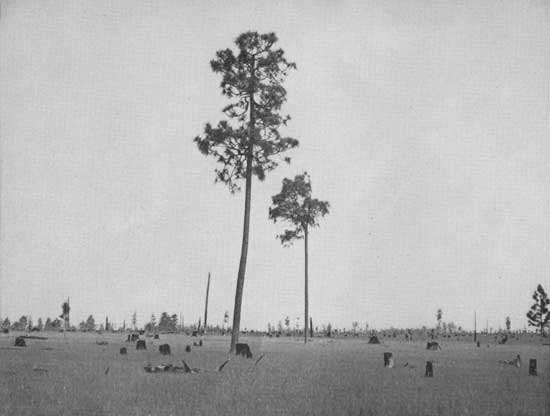
| MILLIONS of acres of privately owned forest land are denuded or so poorly stocked that they can be classed only as idle. With protection some will reproduce naturally, but about 25 million acres require planting. It is a 100-year job at the current rate of planting. F-379983 |
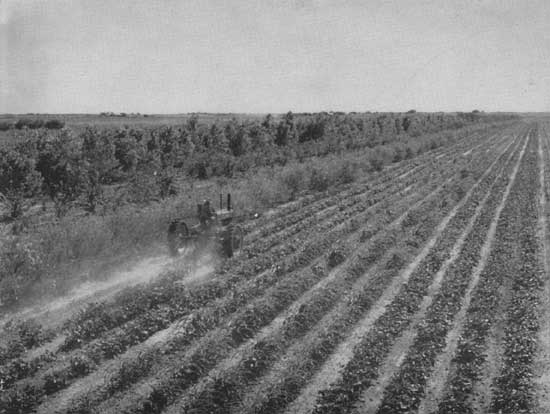 This 2-year-old shelterbelt is already exerting a protective influence on cropland. |
| IN ADDITION, the cooperative planting of field windbreaks (shelterbelts) on farms in the Prairie States proceeds at but a fraction of the pace dictated by the need and justified by the results. Shelterbelts retard wind velocity, prevent wind erosion, conserve soil moisture, increase crop yields, and enrich the lives of families. F-366558 |
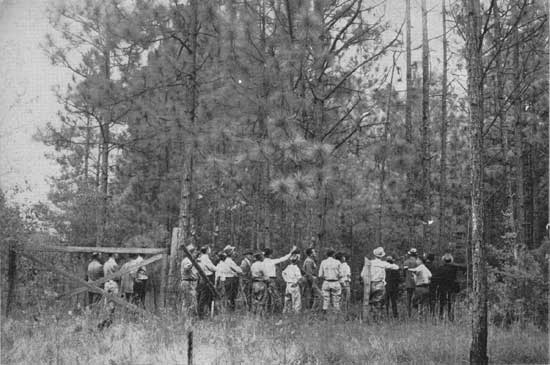 Timber owners studying the results of forest experiments—South Carolina. |
| NOTWITHSTANDING notable exceptions, forest landowners have been slow to adopt good forest practices. Lack of knowledge of how to do a better job and make it pay is the reason in many cases. The gap between research and the application of results of research by four and one-half million farm and industrial owners is much too wide to bridge with current extension facilities. F-390234 |
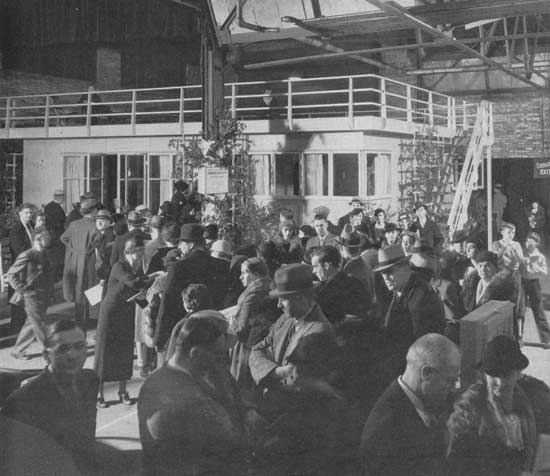 Demonstrating all-wood prefabrication of low-cost homes. |
| READY markets for timber products are essential if we are to grow more timber and thereby stabilize and increase employment opportunities. Forest owners, particularly the smaller ones, must keep abreast of new and improved markets for wood. Consumers must learn its many new uses and how to get the best possible service from wood. Utilization extension would do these things, but it is one of the most neglected public efforts in forestry. F-26002M |
|
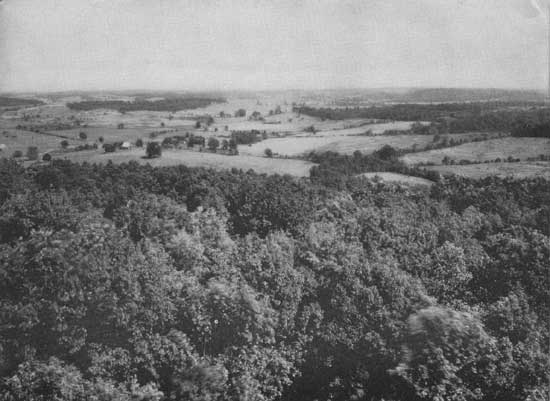
| ONE-THIRD of our commercial forest land is an integral part of farms. Too often farm woodlands are mismanaged and subject to heavy cutting by farmers sorely in need of supplemental income. Benefit payments to farmers for improved forest practices are a part of the agricultural conservation program of the Federal Government but have not yet assumed large importance. F-351651 |
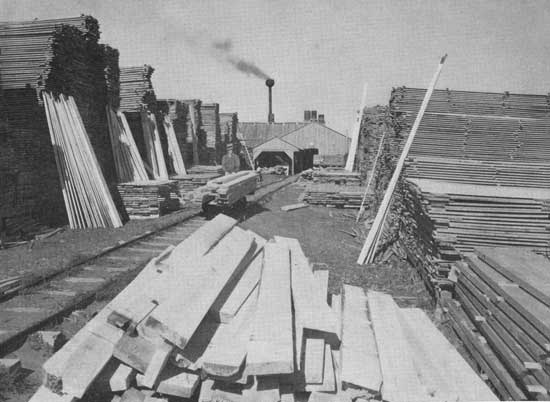 Example of facilities required for lumber production—beyond the means of small forest owners except through cooperative organization. |
| WOOD marketing, manufacturing, and management problems are difficult for farm and other small owners. Pooling of resources through cooperative organization gives each individual a better chance to realize on his timber and to manage it for continuous production. Federal and State assistance has fostered the development of several small owner cooperatives, but the field has scarcely been scratched. F-368002 |
|
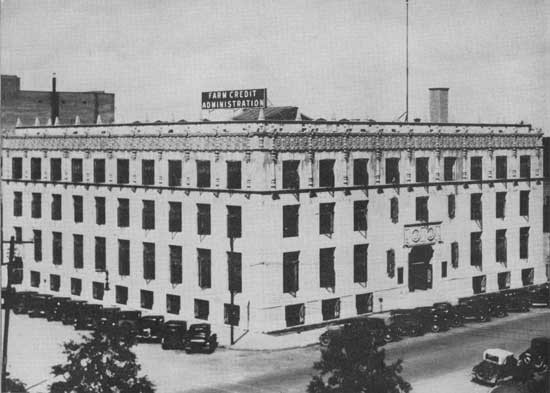
| SUITABLE public credit facilities for industrial and nonfarm forest owners are not now available. The terms of private lenders usually require rapid cutting and early retirement of loans, so that long-range management plans, consolidation of ownerships, and other adjustments necessary to practice good forestry are often out of question even for well-intentioned operators. FSA-P2125 |
|
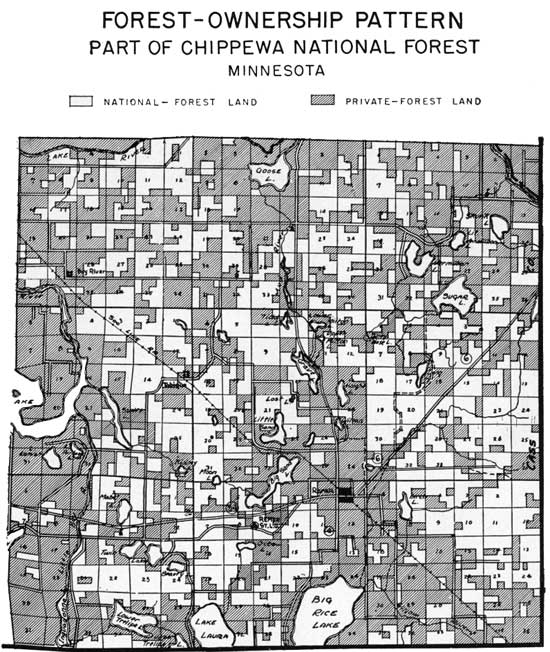
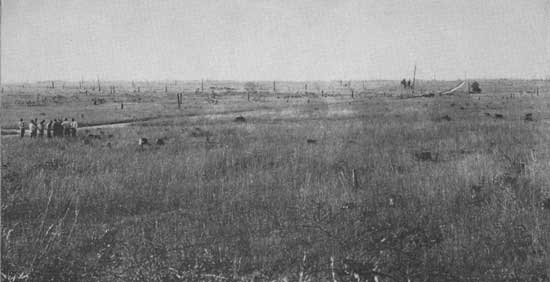
| JUDGED BY the need, public acquisition of forest lands has proceeded at a snail's pace. The national-forest area shown is typical of complex ownership patterns which in numerous instances handicap adequate protection and management. F-396958 |
|
| MILLIONS of acres of farm and nonfarm forest lands are partly or nonproductive. Little or nothing is being done to restore productivity. Vast numbers of people are on relief in denuded rural areas. Here's a great need and opportunity to put idle men and idle land to work again. F-264832 |
|
PRIVATE FOREST-LAND PROBLEMS UNSTABLE ownership of large areas of forest land, which precludes adequate protection and management. Multiplicity of intermingled ownerships, which compound the inherent difficulties of forest-land management. Overlapping, often ill-defined, and sometimes conflicting Federal, State, and local interests, responsibility, and authority. Wide variation in objectives between classes of ownership and within the same ownership classes. Inadequate technical knowledge of how to handle forest lands. Difficulty, with present extension facilities, of making existing knowledge available to the extremely large number of scattered forest owners. Special handicaps of small unorganized owners, who in the aggregate control 139 million acres of commercial forest land: Manufacturing and marketing facilities; management problems, etc. The problem of completing the change which has already begun, of the philosophy of forest owners from that of liquidation to that of forest management. Inequitable tax practices. Hazards of fire, insects, and disease. Underdevelopment of new uses and markets for wood. The lack of suitable forest credit facilities for industrial and nonfarm forest owners. Twenty-five million acres of idle forest land in need of planting. Millions more in semiproductive condition in need of rehabilitation. |
| THESE are some of the private forest-land problems. Their solution is a matter not for the private owner alone, nor for the public alone just because it has an interest in private forest lands. Action by both is required and is equitable. |
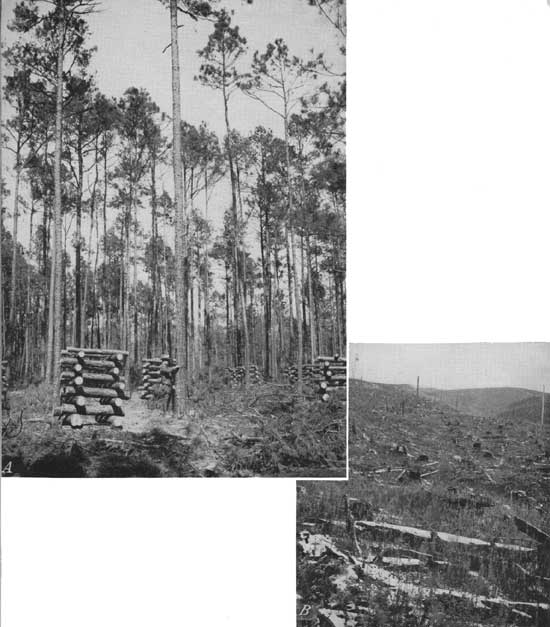 Examples of good and bad forest practices—both on private lands. |
| PUBLIC cooperation will help solve the forest problems. But reasonable public controls are also needed to insure cooperation by private owners, to safeguard public expenditures, and to stop destructive practices on the part of some owners and operators. F-363611 AND F-320978 |
|
|
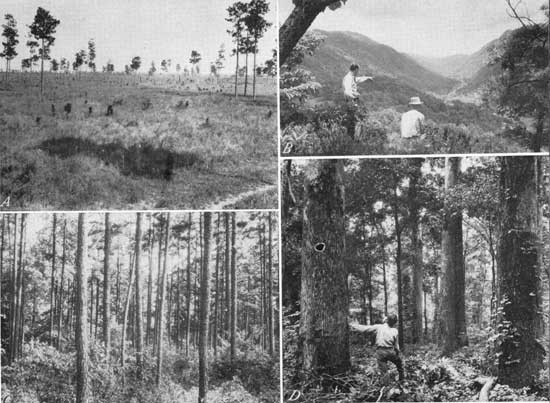
EVEN with adequate cooperation and reasonable
regulation there would still be forest lands submarginal for private
ownership and management, but none the less important for stream-flow
stabilization and soil erosion control, that would not be reached. There would be others scrambled in a hopeless ownership pattern that precludes adequate protection and management, and still other areas of old-growth timber, threatened by liquidation, which hold key positions and govern the type of management feasible on adjacent areas. For these lands, public ownership—community, State, or Federal—appears to be the only answer: A, Heavily cut forest; B, watershed-protection forest; C, immature shortleaf pine typical of some tracts acquired by the Federal Government to consolidate holdings; D, old-growth bottom land hardwoods purchased to forestall liquidation cutting. F-296787, F-381134, F-250493, AND F-386657 |
| <<< Previous | Next >>> |
|
misc-414/sec6.htm Last Updated: 30-Jan-2009 |