|
A PRIMER OF FORESTRY PART II—PRACTICAL FORESTRY |

|
CHAPTER II.
WORK IN THE WOODS.
The products of the forest are among the things which civilized men can not do without. Wood is needed for building, for fuel, for paper pulp, and for unnumbered other uses, and trees must be cut down to supply it. It would be both useless and mistaken to try to stop the cutting of timber, for it could not cease without great injury, not to the lumbermen only, but to all the people of the nation. The question is not of saving the trees, for every tree must inevitably die, but of saving the forest by conservative ways of cutting the trees. If the forest is to be preserved, the timber crop now ripe must be gathered in such a way as to make sure of other crops hereafter.
In general, it is true that the present methods of lumbering are unnecessarily destructive and wasteful. This is not because lumbermen are more greedy of gain or less careful of public interests than other business men, for they are not. It happens partly because in this country, compared with France and Germany and other densely populated regions, there is so much timber in proportion to the population that it does not pay the lumberman to take anything more than the better parts of the trees he fells. The lumberman can not do his work unless he does it at a profit, and he must do it, for lumber is indispensable. Consequently, although much of the waste in lumbering is not only unnecessary, but actually costly to the lumberman, for the present it is impossible to avoid waste altogether. It will be easier to do when the methods and advantages of conservative lumbering, which is forestry, are better known to the American lumbermen, and are therefore in more general use. Although rough conservative methods have often been practiced in the past, the success of the lumbermen who made the trial was generally but partial, because their knowledge of the forest was partial also. They were often deceived by underestimates of the capacity for tree growth of the lands they were handling, because accurate measurements were wanting, and they seldom made full use of the reproductive power of the forest. More recent attempts, based on better knowledge, have been successful in almost every case.
Lumbermen in America are second to none in skill and ingenuity, in the perfection of their tools, and in the effectiveness of the methods they have devised. The nations of Europe, although they have given far more attention to forestry than we, are very much behind the United States in these respects. So it is not surprising that Americans have been slow to change their methods, especially when methods and lumbermen alike have often been attacked as wrongly and intemperately as the foreign methods have been praised and recommended. German methods would be as much out of place in America as American methods in Germany. What American foresters should do and are doing is to combine the general principles of forestry, which are true all the world over, with American methods of lumbering. The product will be a system of forestry especially adapted to the United States. The foundations of such a system are already laid.
|
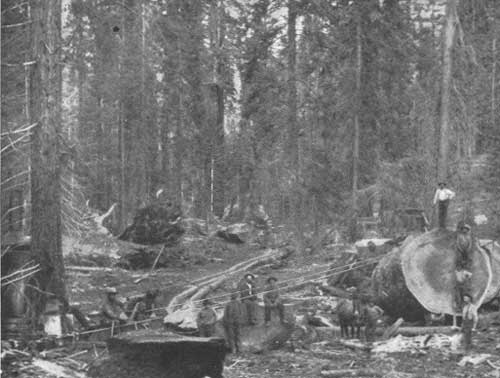
| Figure 23.—Logging of great mechanical perfection among the Big Trees of California. |
CONSERVATIVE LUMBERING.
Something was said in the last chapter about the systematic methods of conservative lumbering. With the gradual understanding and application of these methods by American lumbermen, already well begun, and with the work in the woods rightly carried out, there is but one reason why the great majority of the forests now standing in the United States should not in the end be lumbered steadily and systematically, or why they should fail to yield a steadily increasing return. That reason is the rapid destruction of the forests themselves. There is grave danger that the best of our forests will all be gone before their protection and perpetuation by wise use can be begun. The spread of a working knowledge of practical forestry is likely to be too slow.
CONSERVATIVE LUMBERING AND ORDINARY LUMBERING.
Conservative lumbering is distinguished from ordinary lumbering in three ways:
First. The forest is treated as a working capital whose purpose is to produce successive crops.
Second. With that purpose in view, a working plan is prepared and followed in harvesting the forest crop.
Third. The work in the woods is carried on in such a way as to leave the standing trees and the young growth as nearly unharmed by the lumbering as possible.
|
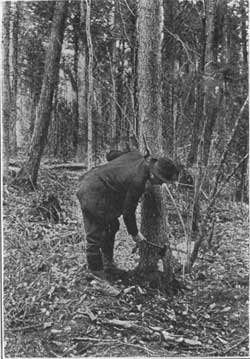
| Figure 24.—Government forester marking trees to cut. Adirondack Mountains, New York. |
A forest working plan is intended to give all the information needed to decide upon and carry out the best business policy in handling and perpetuating a forest. It gives this information in the form of a written statement, which covers some or all of the following topics. It shows the present stand and condition of the forest, and gives rules for the selection and marking of trees to cut, for making the reproduction sure, and for the protection of young and old standing trees during the logging. The working plan also predicts the future yield of the forest, basing its prediction on careful measurements which show how many standing trees of different diameters will be left per acre after the first cutting, and how fast these young trees grow. Finally, it estimates the future return in money, taking into account the taxes, interest, and other expenses on one side, and the future crop on the other. In order to make this estimate entirely safe, it is usually based on the present price of stumpage, although its future value will certainly be much higher.
FELLING THE TREES.
The difference between the practical work under ordinary lumbering and under conservative lumbering is chiefly in the selection of the trees to cut, in felling them, and in the first part of their journey from the stump to the mill. Under a working plan the trees to cut are chosen in such way that when they are gone the forest will suffer but little from their absence, because their places will be taken by others as quickly as possible. Usually the trees selected are first stamped with a marking hatchet to prevent mistakes, and then the next step is to cut them down.
The amount of harm done to the forest by cutting depends considerably upon the season of the year when the work in the woods is carried on. Less damage results to the young growth and the trees left standing if the lumbering is done after the growing season is over than if it goes on in the spring and summer, while the bark is loose and the leaves and twigs are tender.
|
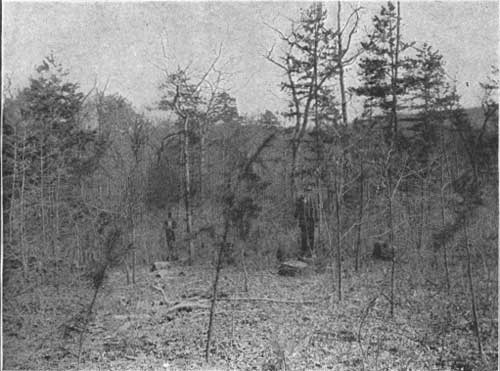
| Figure 25.—Low stumps in logging. |
A tree may be felled either with the ax or with the saw. In either case the first thing to consider is the height above the ground at which the cut is to be made. High stumps needlessly waste the best timber in a sound tree. Low stumps are slightly more difficult to cut, and therefore a little more expensive, but the additional cost is more than balanced by the gain.
The measurements made by the Bureau of Forestry have shown that the loss from cutting high stumps on a tract of 100,000 acres in the Adirondacks, yielding on an average 15 standards per acre, would be 30,000 standards, or at a stumpage value of 50 cents per standard, would be $15,000.
|
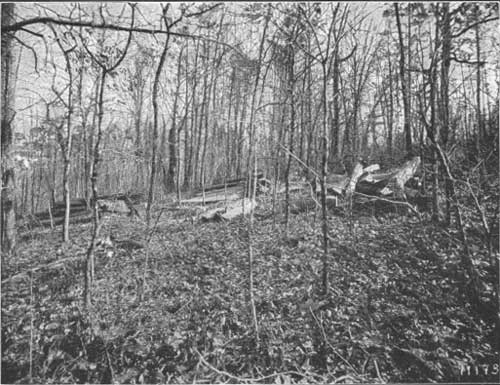
| Figure 26.—Protection of young growth in logging. Biltmore, N. C. |
The second thing to consider in felling a tree is how to get it down without breaking or splitting the trunk. On rocky, uneven ground this is often a hard thing to do, but unless it can be accomplished the tree would, as a rule, better be left untouched.
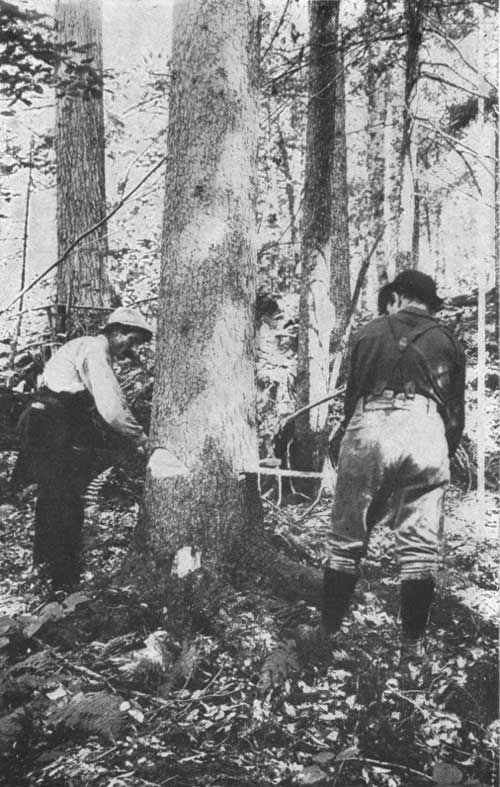
|
| Plate X. CONSERVATIVE LUMBERING IN THE ADIRONDACK MOUNTAINS, NEW YORK. Note the height of the stump. |
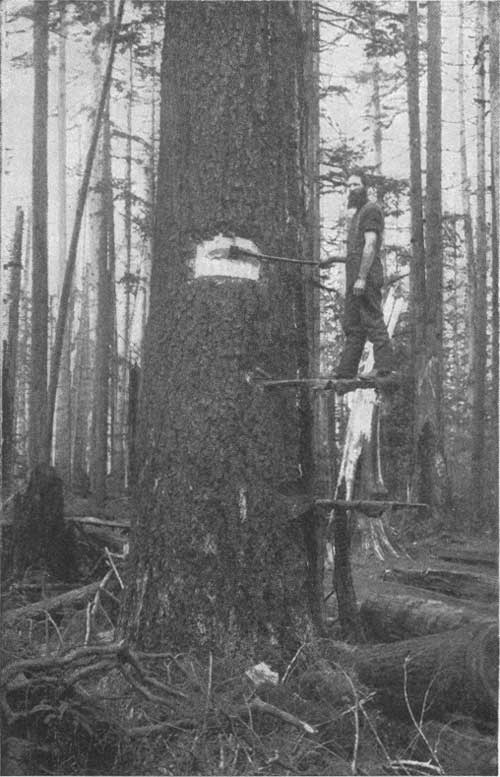
|
| Plate XI. WASTEFUL LUMBERING ON THE PACIFIC SLOPE. Note the height of the stump. |
Most important of all for the perpetuation of the forest, each tree must be thrown where it will not unnecessarily injure other trees or crush in its fall the young seedlings on which the future of the forest depends. It happens very commonly in ordinary lumbering that vigorous, sound young trees are split and ruined in great numbers by old trees falling upon them, when it would be perfectly easy, and almost or quite as convenient, to throw the latter where they would do little or no harm.
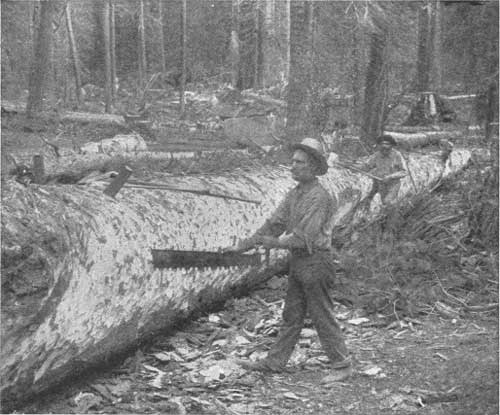
|
| Figure 27.—Sawing fir into logs. Washington. |
Finally, it must cost as little as possible to fell each tree, for to be successful conservative lumbering must pay.
SWAMPING AND SAWING.
|
| Figure 28.—Sawing up a Big Tree. California. |
When the trees are down, their lower branches are chopped off and the trunks are sawed into logs. In falling, a tree is very apt to bend and hold down beneath its trunk and branches many younger trees, which will spring up straight again if they are quickly released, but which otherwise will be killed or permanently hurt. Therefore it is very important to work up both the trunk and the top of each tree as soon as it is cut down, and so prevent it from destroying the young trees which should take its place. Except when they are to be burned, even the branches of tops which can not be used should ordinarily be cut away enough to let the tops sink close to the ground, where they will rot as speedily as possible. Dry crowns propped clear of the ground by their branches rot slowly, burn fiercely, and are very dangerous in case of fire. (See Pl. I.)
|
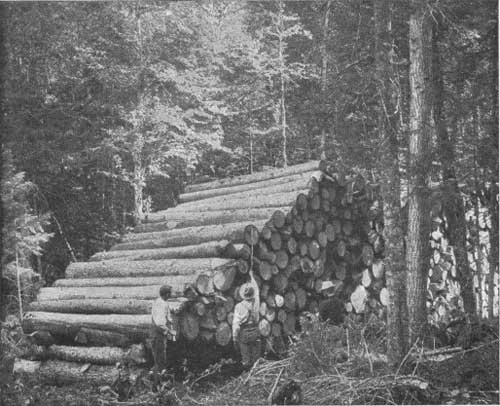
| Figure 29.—Spruce rollway. Adirondack Mountains, New York. |
|
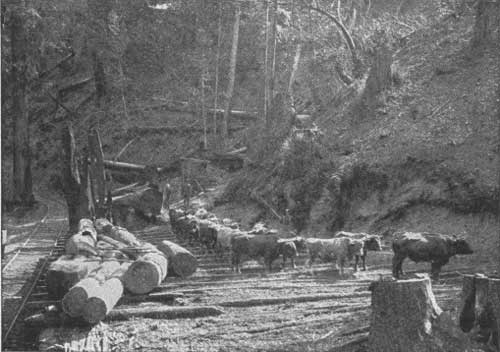
| Figure 30.—Skidding with oxen. Washington. |
SKIDDING.
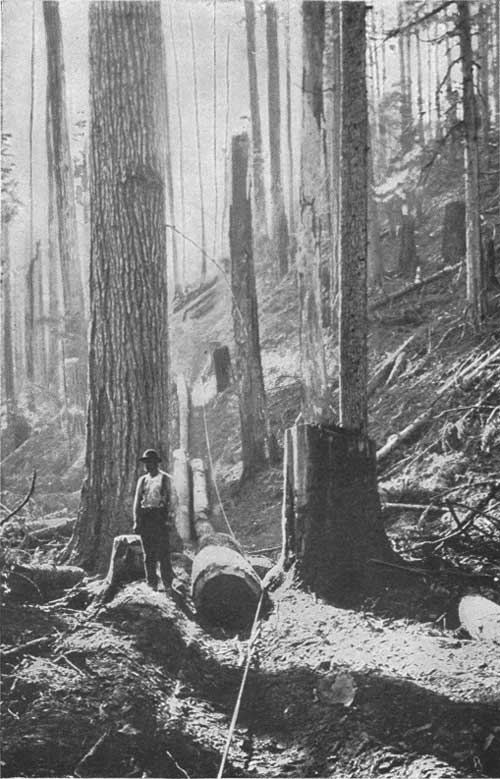
When the trunks have been sawed into logs, the latter are dragged away by horses, mules, or oxen, or in some cases by a long wire rope which is would on the drum of a donkey engine. This is called "skidding the logs." In this way they are collected in piles called "rollways," or assembled in "yards," or otherwise made ready for the next step in their progress to the mill.
|
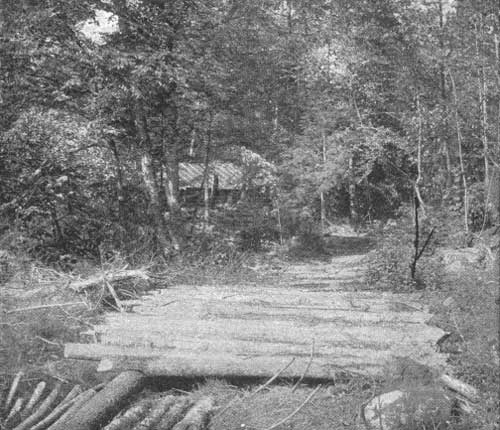
| Figure 31.—Destructive use of young spruce for road building. Adirondack Mountains, New York. |
Care is needed in skidding not to rub or tear the bark from valuable standing trees, or to break the young growth down, for much harm is quickly done in this way. Promising young trees are often cut because it is easier to use them for corduroy or skids, or for other purposes in the logging than to take others less straight or less conveniently at hand, or because they are somewhat in the way, or even from habit, when it would really be easier to let them alone. A very little care in preserving young growth makes an astonishing difference in the future value of a forest.
|
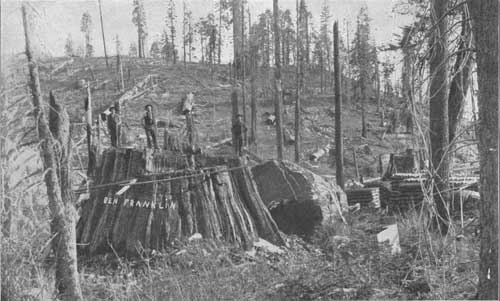
| Plate XII. DESTRUCTIVE LUMBERING IN THE SOUTHER SIERRA NEVADA MOUNTAINS, CALIFORNIA. |
|
| Plate XIII. WIRE-ROPE SKIDDING. WASHINGTON. |
TRANSPORTATION.
|
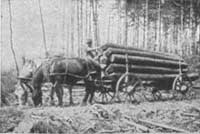
| Figure 32.—Logging white cedar by team. New Jersey. |
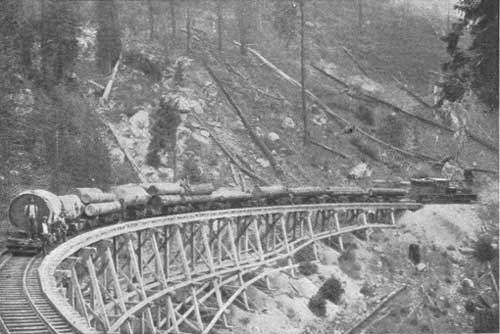
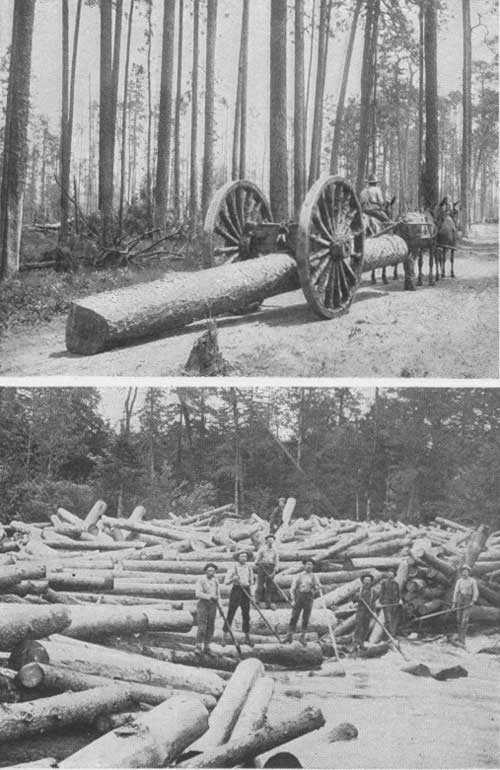
After the skidding, the logs may be transported to the sawmill in many different ways. Sometimes they are loaded on sleds and drawn over carefully made ice roads to a logging railroad or to the bank of a stream. When the stream is not swift or deep enough to carry the logs of itself, splash dams are built, in which great quantities of water are held back for a time. (See Pl. XV.) When such a dam is opened the water is set free, and great numbers of logs may be driven far down the steam by the sudden flood. In larger streams the logs are sometimes made into rafts, or they may be driven singly down the river. The log drivers who do this work learn to balance themselves on the floating, rolling logs, and walk on them almost as easily as on the solid ground. Sometimes locomotives drag the logs behind them over the ties, or they are hauled on cars which run over poles cut in the woods instead of over metal rails; often they are rolled into slides built of other logs, and either move downhill by their own weight or are dragged along by horses, cattle, or steam. In southern swamps the logs are sometimes swung up by a wire rope suspended from the trees, and so are loaded on the great flatboat which carries them to the mill.
|
| Figure 33.—Logging by rail. Sierra Nevada Mountains, California. |
|
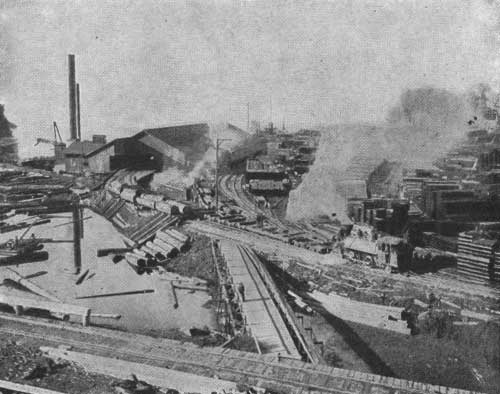
| Figure 34.—A sawmill, log pond and lumber yard. Northern California. |
|
|
Plate XIV. FIG. 1.—HAULING LOBLOLLY PINE. SOUTH CAROLINA. FIG. 2.—RIVER DRIVERS AT WORK ON A LOG JAM. MINNESOTA. |

|
|
Plate XV. FIG. 1.—INTERIOR OF A SPLASH DAM. NORTH CAROLINA. FIG. 2.—LOGS IN THE STREAM BED WAITING FOR THE SPLASH. NORTH CAROLINA. |
AT THE MILLS.
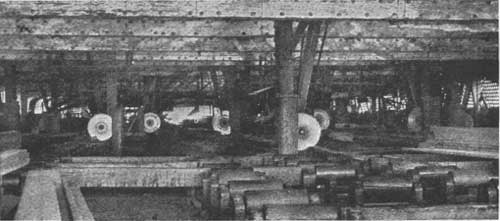
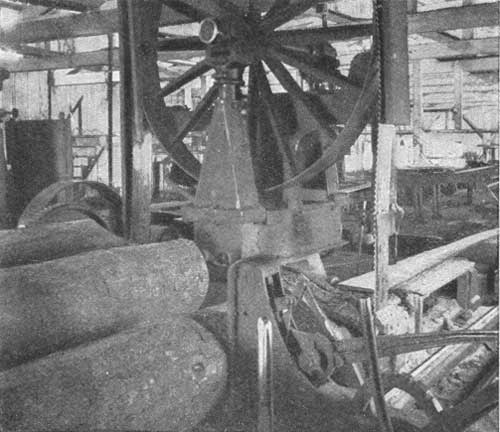
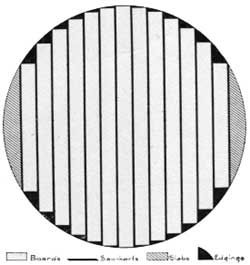
At the mills the logs are cut into lumber by various kinds of saws. Of these the circular saw is still very widely used, although the wide bite or kerf which it cuts in the log makes it very wasteful of timber. A large circular saw makes a kerf a quarter of an inch wide, so that in cutting four one-inch boards enough wood to make a fifth board is ripped into sawdust. Band saws are far less wasteful, for they are thinner and make a narrower kerf. Hence they are taking the place of the circular saws, although they do not work so rapidly. Many mills, in addition to their band saw or circulars, use gang saws, which cut out several boards at the same time.
|
| Figure 35.—Circular saws (edgers) in a Puget Sound sawmill. |
Besides lumber the best sawmills produce great quantities of lath and shingles, made either from small logs called "bolts," cut specially for that purpose, or from slabs, edgings, and other pieces of wood which might otherwise be wasted. But in spite of every effort to prevent waste in the mill, by using sawdust and other refuse for fuel, and in other ways, very many thousands of tons of wood a year are thrown into great burners as the cheapest method of getting it out of the way.
|
| Figure 36.—A band saw. Virginia. |
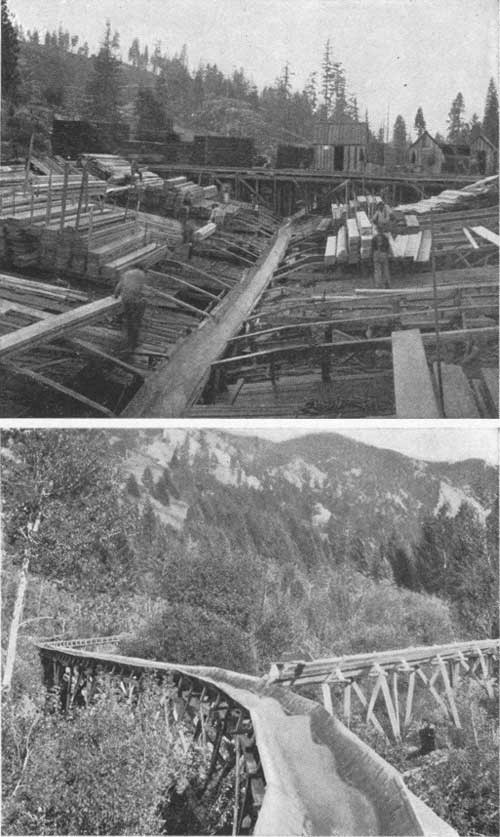
When the lumber has been sawed it may be piled and seasoned in the yard or kiln dried before it is sent to market or sold at the mill. Some sawmills on Puget Sound are built on piles over the water, so that the lumber is loaded into vessels directly from the saws. Others load their product on the cars and distribute it by rail. Still others on the Pacific slope float their timber away in a narrow wooden trough called a flume through which flows a rapid stream of water. (See Pl. XVII.) These flumes are sometimes over 40 miles in length, and cost almost as much to build as a railroad. Many sawmills have connected with them planning mills or woodworking factories of other kinds, so that the rough lumber from their saws is changed into the form of a finished product before it reaches the market.
|
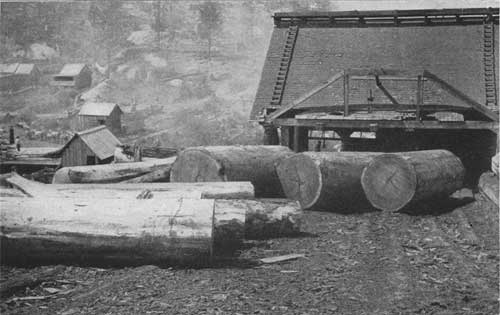
| Plate XVI. BIG TREE LOGS AT THE MILL. MILLWOOD, CAL. |
|
|
Plate XVII. FIG. 1.—THE HEAD OF A LUMBER FLUME. CALIFORNIA. FIG. 2.—THE FLUME IN THE MOUNTAINS. CALIFORNIA. |
WASTE IN LUMBERING.
|
| Figure 37.—Diagram to show the sawing of a log. |
This is very briefly the way in which a tree gets into the market at the end of its life. At every step there is some waste. Although it may be sound throughout, the lumbermen in the woods can take but a portion of the trunk and all of the top to rot on the ground. When each log comes to the saw there is a further loss of nearly all the slabs and edgings and all the sawdust that is not used for fuel. On the average it is doubtful whether more than half of the cubic contents of a standing tree is finally used. As prices rise and as conservative lumbering comes to be generally practiced, the greater part of this enormous loss will be avoided, but it can probably never cease altogether.
PLANTING.
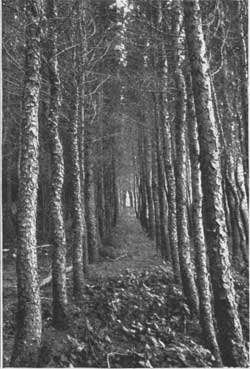
It has often been proposed to plant trees in order to repair the damage done to the forests by the lumbermen. Tree planting is most useful in all the treeless or scantily wooded portions of our country where planted trees will grow, and wherever forests have been very severely injured or destroyed, but it is generally far too expensive to take the place of conservative lumbering in regions already forested. An acre of growing natural forest can be bought in nearly every forested part of our country for less than it would cost to plant, 4 feet apart, an acre of seedlings a few inches high. The true way to save the forests is not to plant new ones, but to protect and rightly use those which are standing now. The extension of the forest to regions which are without it is a most important task, but it must not be confounded with the conservative use of the forests now standing. For such use there is no substitute whatever.
|
| Figure 38.—A European larch grove in western Minnesota. Cost of planting per acre 17 years ago, $64.45. Present value per acre, $484. |
| <<< Previous | <<< Contents>>> | Next >>> |
|
primer/chap2-2.htm Last Updated: 06-Jul-2009 |