|
A PRIMER OF FORESTRY PART II—PRACTICAL FORESTRY |

|
CHAPTER III.
THE WEATHER AND THE STREAMS.
The central point of public interest in forestry in the United States was until recently the influence of forests on climate. It is natural that the connection between the immense forests and vast plains and the wonderfully various climates of this continent should have awakened attention. It is a matter which is easily written and talked about without any thorough understanding of forestry itself, and in this it differs from other branches of the subject. In dealing with the weather it touches a thing which affects the daily life of everyone, and which, to very many, holds the balance between poverty and prosperity. It is therefore unfortunate that so much of the writing and talking upon this branch of forestry has had little definite fact or trustworthy observation behind it. The friends and the enemies of the forest have both said more than they could prove. Both have tried to establish the truth of their opinions by referring to observations of temperature and rainfall which cover too short a time to prove anything, or by hearsay and general impressions, which are not to be trusted in such matters. Such discussions make nothing clear except that the pith of the matter has not been reached by either party.
FORESTS AND CLIMATE.
The discussion of forest influence on climate began in this way. When the French revolution broke out in 1789, the old restrictions on the management of private forests were done away. A wholesale cutting of these timberlands promptly followed, and as early as 1792 the consequences began to be observed. The question of forests and climate was then raised for the first time; but questions of this kind can not be answered without long and careful observations. Such observations were begun by Becquerel in France and Krutsch in Germany about the middle of the last century, but it was not until 1867 that a satisfactory way of making them was devised. This was the system of double stations—one within the forest, the other at a distance in the open. It was first put in operation by Professor Ebermayer, now of the Bavarian Forest School. By this means the amount of moisture and heat in the forest may be compared with that in the open, and in the end a full and satisfactory answer will probably be reached.
In order to find how great the influence of forests on climate may be, we must first see what are the factors which make climate. Then we may ask which of these factors can be affected by the forest, and in what way.
The climate of any place on the earth's surface results from the action of the sun's heat upon it. Climate is the average condition of the weather. It depends, first of all, on the distance of a place from the equator and its elevation above the sea. Secondly, it depends on the distribution of land and water, the relief of the land, whether flat, hilly, or mountainous, and the character of the surface covering. These are all connected with the temperature in a special manner. Lastly, it is affected by the winds and the moisture of the atmosphere. Now, it is clear that of all these factors of climate the forest can influence only the wind, the moisture, and the surface covering; but heat (with which the surface covering has so much to do), moisture, and wind are the three things which change when we say that the weather changes. These are just the points where a change due to the forest would have most effect on daily life. The influence of the forest is exerted upon them in two ways;
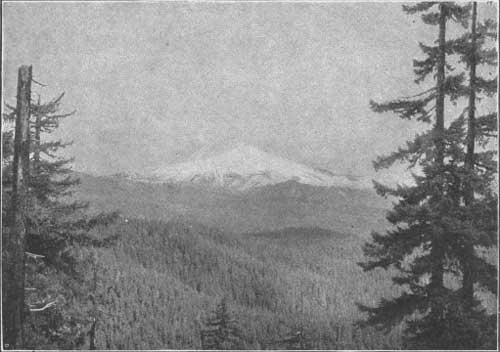
|
| Figure 39.—The forest cover. Oregon. |
First. The forest cover intercepts the rain and the rays of the sun, checks the movement of the air, and reduces the radiation of heat at night.
Second. The waste from the trees and from certain plants which grow only in their shade forms the forest floor, which has much to do with the movement of water on the ground and within it. The influence of the forest cover and the forest floor appears in the temperature of the air, the evaporation of water, the rainfall, and the course of the rain water after it has reached the earth.

|
| Figure 40.—The forest floor. Idaho. |
EFFECT OF FOREST COVER ON TEMPERATURE.
So far as the influence of the forest is concerned, the temperature of the air is affected chiefly by the forest cover. The leaves, which compose the greater part of the cover, contain from 50 to 70 per cent of water. More heat is required to raise the temperature of a point of water one degree than for a pound of almost any other substance, and so it happens that bare soil or rock exposed to the rays of the sun becomes heated many times faster than the water in the leaves. While the heated rock or soil was warming the air about it the forest cover would still be absorbing heat and keeping the air below it cool. The leaves of the cover also tend to cool the air by transpiration, which is the evaporation of water from the leaves. This is water vapor, and a part of the sun's heat is taken up for this purpose. In these two ways the forest cover acts somewhat like a surface of water.
The growth of the tree itself also helps to cool the air. When the leaves take carbonic-acid gas from the air they break it up and force its carbon into new chemical compounds, which are then stored away as new material in the tree. So with water and the other substances upon which the plant feeds. But the elements are less at ease in these new compounds, and heat is required to force them to make the change. When we burn wood for fuel we are simply getting back again the heat which was used to bring about this change. So we may say roughly that the air about the tree during its lifetime has been deprived of as much heat as would be given off if the whole tree were burned.
The effect of the cooler air of the forest is felt to some distance in the open country. During the day, in calm summer weather, when the air is warmer than the tree tops, it is gradually cooled by contact with the cooler leaves and twigs. In cooling it becomes heavier and falls toward the ground. A rising current of warmer air is formed to supply its place, and so the colder air flows off along the surface into the open country and causes local breezes. At night the air currents are reversed. The air in the forest is then warmer than the air outside, because the cover checks the radiation of heat, and so the colder air moves from the open country toward the woods. In these ways the influence of the forest is felt at a distance.
The amount of this cooling of the air has been measured in certain places. It is naturally found to be greatest in summer; while in winter and at night the air in the tree tops is a little warmer than in the open. It is important to add that the cooling effect of the forest is greater than the average in the mountains, and less in the plains.
EXTREMES OF HEAT AND COLD.
The extremes of heat and cold are moderated by the forest. Observations on this point have been made, for example, in Bavaria and Wurttembert. They showed that the lowest temperature of every day in the year was higher, on an average, by nearly 2° in the forest, while the highest temperature was lower by nearly 4°. The greatest heat of the day in the summer was 7-1/2° less in the forest than outside. Prussian observations showed that for ten years the greatest heat of the day in July was, on an average, nearly 6° lower in the forest, and the greatest cold of the night in January nearly 3° less than outside. It should not be forgotten that the latitude, the elevation, and the exposure had a powerful influence on these differences, which are also greatly affected by the kind of trees and the density of the forest.
It must be borne distinctly in mind that the figures given above are reliable only for the places in central Europe where they were observed. But the principles on which they depend are just as true in America as they are in Europe. Natural laws are the same the world over. It is safe to conclude, then, that in the United States the forest modifies the temperature of the air in certain ways and for certain reasons, both of which we have seen. Just how great this influence is in different parts of the continent it is as yet impossible to tell. But it is probably greater on the average than these observations indicate, for two reasons: First, the extremes of heat and cold, moisture and dryness, are much greater here than in central Europe, and changes are more sudden; second, in most of the double stations mentioned above the station outside the forest was within less than a mile of it, and thus likely to be influenced by the cooler air currents flowing from it; that is, the real effect of the presence or absence of woods over large stretches of country is probably greater than these observations show.
A system introduced in Austria is expected to give a clearer idea of the distance to which the forest influence reaches. It consists of lines of stations beginning in the center of a large forest and extending step by step into the open country beyond.
MOISTURE IN FOREST AIR.
The moisture of the air is greater in the forest than outside. The absolute quantity of water vapor in a cubic foot of air is generally the same in both places, but the forest air is cooler, and therefore its relative humidity is greater. Relative humidity is the amount of vapor actually in the air, expressed as so much per cent of all it could hold at the same temperature. The amount of water that the air can hold changes when the temperature changes, but in such a way that air cooled until it is only half as warm as before can hold much less than half as much vapor. If a hot and a cold stream of air, both saturated with water vapor, meet and mix, the mixture can no longer hold as much vapor as the two streams separately, and a part is condensed, usually in the form of rain or snow. German and Swiss observations have shown that the average humidity is greater in the forest by from 3 to 10 per cent. This difference increases with the altitude above sea level and the density of the forest cover. The increase of humidity explains why dew is more frequent in the neighborhood of the forest than at a distance.
EVAPORATION.
The water which falls to the earth from the atmosphere had first to be evaporated, so that year by year the quantity of water which the air takes from the surface of the globe by evaporation is the same as that which falls upon it in the shape of rain, hail, snow, and dew. The effect of the forest on this great movement of water is to detain more of it on those portions of the earth which are sheltered by trees. It does this partly by tending to increase the rainfall, but its effect in lessening the loss of water through evaporation is probably much more important. The colder and moister air of the forest has less capacity for taking up water vapor than that of the open country. It is also quieter, which means that the winds are less active in replacing saturated air with air which can still take up more water. The forest acts powerfully in checking the force of the winds because the elastic swaying of the twigs and branches is a very effective hindrance to the movement of the air. Strong winds, although they are often dangerous in themselves, do most harm by drying up the moisture in the soil and in the plants which grow from it. Thousands of miles of windbreaks have been planted by farmers in the western parts of this country to protect their crops and homes against the wind. These windbreaks serve a most useful purpose, but they are naturally far less effective in preventing evaporation than the forest itself. So great is the power of the latter that direct observations made in Bavaria and Prussia showed that evaporation from a free surface of water in the forest was only 40 per cent of that in the open.
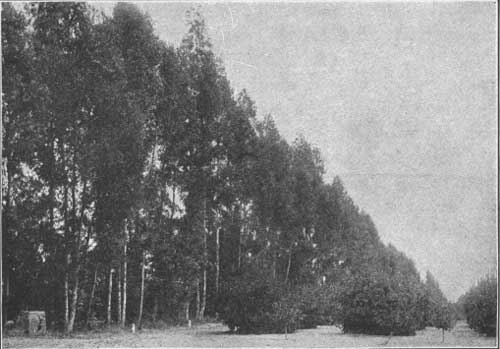
|
| Figure 41.—A windbreak. California |
The presence of absence of leaf mold has a powerful effect on the amount of evaporation from forest soil. The experiments of Dr. Ebermayer, a famous German forest meteorologist, showed that evaporation from forest soil without a layer of mold was 47 per cent of that from soil in the open, while with a layer of mold it was less than half as much, or 22 per cent. The greater the altitude above the sea the greater is the effect of the forest in preventing evaporation. This is a powerful reason for preserving mountain forests at the headwaters of streams, especially in the Rocky Mountain regions of the United States. Evaporation is there so active that great banks of snow lying in the full glare of the sun often disappear without melting even enough to moisten the ground on the hillsides below them. Vast quantities of water evaporate in this way without ever reaching the streams. Measurements made by the Bureau of Forestry show that evaporation from snow may be four or five times as great as from water under like circumstances.
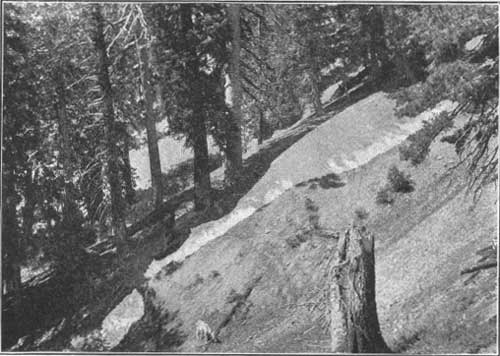
|
| Figure 42.—A snow bank evaporating. San Gabriel Mountains, California. |
RAINFALL.
The causes of rain are for the most part wholly beyond the reach of influence from the forest. Such are the great currents of warm and cold water in the ocean, the direction of the prevailing winds, and the presence or absence of mountain ranges. But there are two reasons which lead us to believe that forests do affect the rainfall. These are their colder and moister air, and the resistance which they offer to the motion of the winds. A great number of observations has been made in different parts of the world to discover how much the rainfall really is affected by the forest, but for several reasons no generally accepted result has yet been reached. In the first place, accurate observations on rainfall are not easy to make. The height above the ground at which a rain gauge is placed affects it very seriously. A variation of 10 feet in height will often make more difference in the amount of rain caught than most observers claim for the whole action of the forest. The rainfall of two stations at unequal heights above sea level is sometimes wrongly compared, because the difference in rainfall may be caused by the difference in altitude. Finally, the best observations that have been made point to different conclusions. For example, measurements taken in Prussia go to show that there is an increase of rain over the forest, and that it is greater the higher the station. Thus, near the level of the sea it was only 1.25 per cent greater than over the open country, while at altitudes between 2,000 and 3,000 feet it reached 43 per cent. Observations made a Nancy, in France, which lies about 700 feet above the sea, show an average yearly increase of 16 per cent. The Bavarian observations, on the contrary, do not indicate more rain over the forest. The best evidence at hand fails to show a decrease in rainfall over the United States in the last hundred years, in spite of the immense areas of forest that have been burned and cut. But it should not be forgotten that most of those areas have grown up again, first with brush, and afterwards with trees, so that the proportion of land covered with leaves is still very large in all part of the country which was once under forest. In India, again, a large amount of statistics has been collected which leads to the conclusion that forests do influence rainfall. The truth probably is that more rain falls over the forest than over open country similarly placed, but how much more it is impossible to say. The excess falls chiefly in the form of summer showers. One of the best in the form of summer showers. One of the best authorities has estimated the differences at 10 per cent.
FALLEN RAIN.
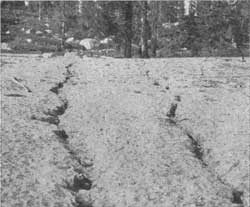
|
| Figure 43.—The beginning of erosion in soil tramped bare by stock. Sierra Nevada Mountains, California. |
Whatever doubt there may be about the action of the forest in producing rain, there is none about its effect on rain water after it has fallen. When rain falls over a dense forest from less than one-tenth to about one-fourth of it is caught by the trees. A small part of this water may reach the ground by running down the trunks, but the greater part of it is evaporated and so increases the humidity of the air. That which passes through the crowns falls upon the forest floor, which sometimes has an absorbing power so great that it can hold for a while a rainfall of 5 inches. Yet this water does not remain in the porous floor, but in the end runs off into the streams, or is evaporated, or sinks into the ground. That which gets into the ground is either taken up by the roots or goes to feed the springs and watercourses.
Rain which falls over a bare slope acts differently. It is not caught by the crowns nor held by the floor, nor is its flow into the streams hindered by the timber and the fallen waste from the trees. It does not sink into the ground more than half as readily as in the forest, as experiments have shown. The result is that a great deal of water reaches the streams in a short time, which is the reason why floods occur. It is therefore true that forests tend to prevent floods. But this good influence is important only when the forest covers a large part of the drainage basin of the stream. Even then the forest may not prevent floods altogether. The forest floor, which has more to do with the fallen rain water than any other part of the forest, can affect its flow only so long as it has not taken up all the water it can hold. That which falls after the forest floor is saturated runs into the streams almost as fast as it would over bare ground.
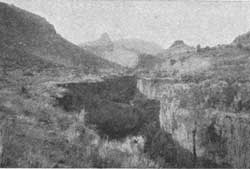
|
| Figure 44.—Rapid erosion in deep fine soil. |
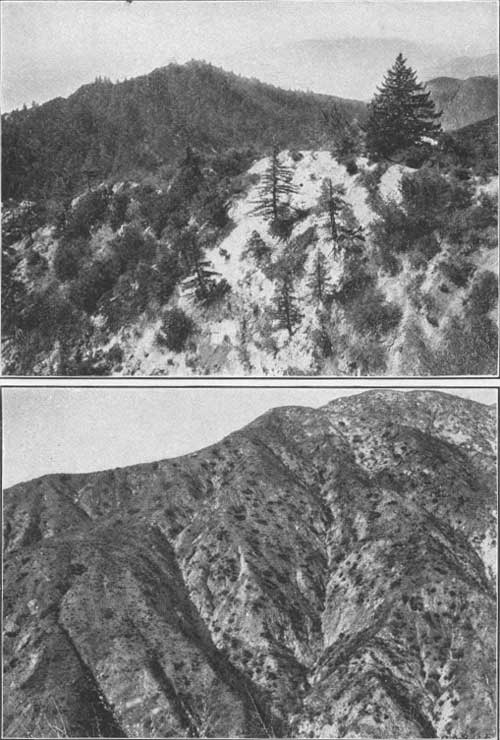
An unforested drainage basin in the San Bernardino Mountains of southern California was found by the Bureau of Forestry to discharge the rain it received more than twice as rapidly as similar forested basins near by. In consequence, the stream in the former went dry, while the streams in the latter were still flowing abundantly. (See Pl. XVIII.)
In these ways it happens that in mountain countries, where floods are most common and do most harm, the forests on the higher slopes are closely connected with the prosperity of the people in the valleys below.
Water in motion was nature's most powerful tool in shaping the present surface of the earth. In places where the slopes are steep, the structure of the ground loose, and the rainfall abundant, water may work very rapidly in cutting away the heights and filling the valleys. The destruction of the forest in such a region exposes the surface to the direct action of falling rain and is certain to be followed by the formation of torrents. The danger is greatest when the soil has been laid bare by the browsing and the hoofs of grazing animals, among which sheep and goats are especially destructive, or where the forest floor has been burned away.
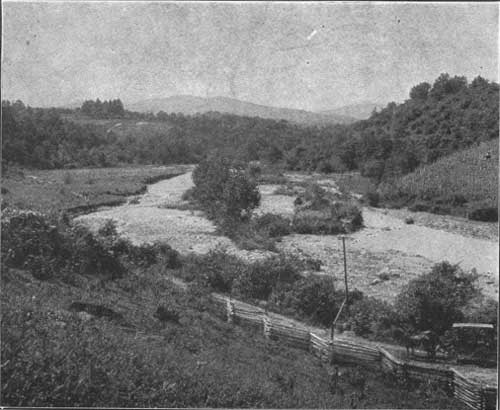
|
| Figure 45. Destruction by flood. North Carolina. |
When these conditions are both present, as in parts of the Sierra Nevada Mountains of California, of the Cascade Range in Oregon, and in many other parts of the West, the prosperity of the valleys is in serious danger. Fire and overgrazing on the mountains combine to endanger the future water supply of irrigated or irrigable areas in the valleys below. When rain falls over mountains which have so been deprived of their natural protection it is no longer caught and held back by the trees and the forest floor. The roots, which were once the strongest means of binding the soil together, now are gone and leave it without protection against the rushing water. Heavy rains or sudden thaws swell the streams with marvelous quickness, and give them a wonderful power to cut away their banks. Where the waterway is very steep such a flood often carries with it many times its own weight of earth and stones. As it nears the valley it breaks from its bed and makes new channels, or spreads over the lowlands. The current loses its swiftness, and its load of stones and sterile earth sinks to the bottom, the heavier pieces first. Where it falls the beds of rivers are filled up and fertile lands are covered with pebbles and sand.
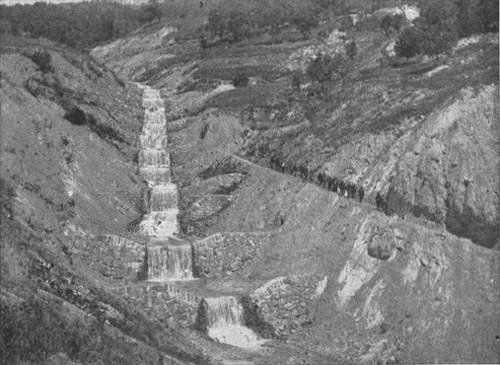
|
| Figure 46.—Masonry dams built to control a torrent. Students of the French forest school at the right. Alps of southern France. |
For a time after such a flood the streams are usually low, because the water which should have fed them for weeks or months has run off in a few days. This may be quite as serious a matter for the farmers as the destruction of their fields, as for example in places like southern California, where the crops depend on irrigation with the water of streams which rise in the mountains. Torrents have begun to form there in the San Bernardino Mountains, and have already carried stones and sand into the orange groves and even into the towns of the San Gabriel Valley. Before the water of the San Gabriel River was so largely taken out for irrigation it was rapidly cutting away the fertile land on either side of its shifting bed, and it seemed likely that serious loss of property would follow. This is the direct result of fire and grazing in the mountains.
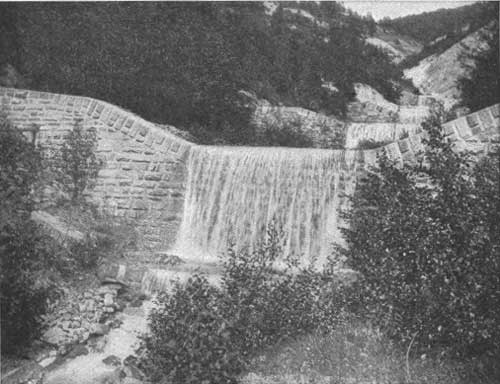
|
| Figure 47.—Plantation of European alder in the bed of a torrent controlled by dams. This torrent is now extinct. Alps of southern France. |
|
|
Plate XYIII. FIG. 1.—FORESTED WATERSHED IN THE SAN BERNARDINO MOUNTAINS, SOUTHERN
CALIFORNIA. FIG. 2.—UNFORESTED WATERSHED IN THE SAN BERNARDINO MOUNTAINS, SOUTHERN CALIFORNIA. |
The pasturage of sheep in the Alps of southern France was the chief cause of the destructive torrents with which the French Government has been struggling for many years. The direct loss to the French people has been enormous, and in addition the work of correction alone has cost upward of $35,000,000. Although wonderfully successful hitherto, it is still far from finished.
| <<< Previous | <<< Contents>>> | Next >>> |
|
primer/chap3-2.htm Last Updated: 06-Jul-2009 |