

|
Popular Study Series History No. 6: New Echota, Birthplace of the American Indian Press |
 |
New Echota Birthplace of the
American Indian Press (continued)
Considering the objectives which it was created to serve and the unusual circumstances of time and place in which it was produced, the Cherokee Phoenix was a good newspaper. While it functioned, on the one hand, as the official organ of a nation, it also did duty, on the other, as something of a "local weekly." That second office was subordinated entirely to the first, however, and the struggling little paper maintained a journalistic standard whose catholic tone and editorial technique merit the respectful attention of present-day students of the press.
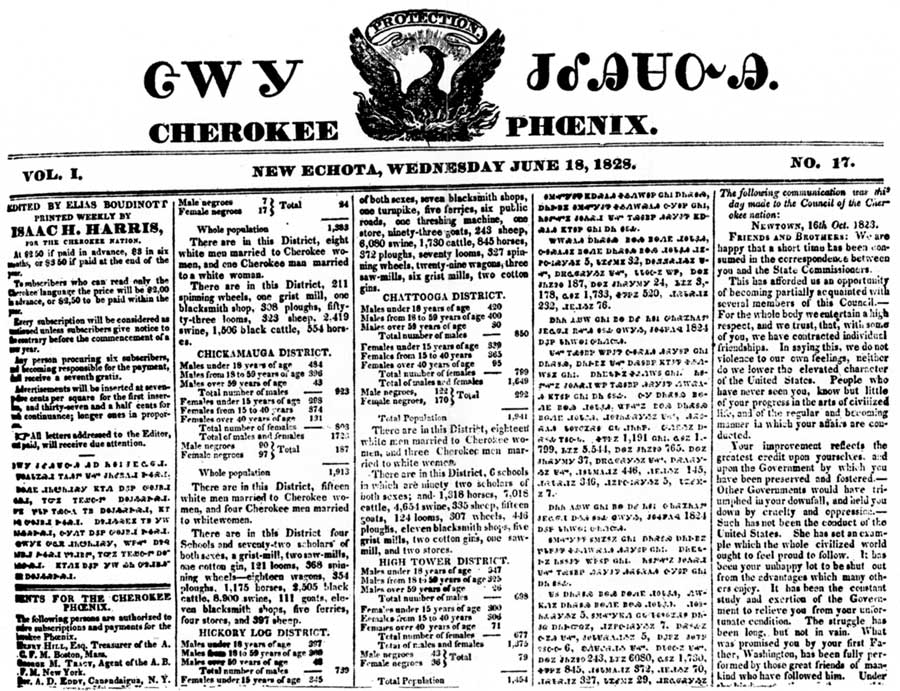 Reproduction above is the upper portion of a typical front page of the Cherokee Phoenix, America's first Indian newspaper, which was published at New Echota, the capital town in northern Georgia. Column 4, printed in Sequoyah's phonetic symbols, reports the result of a general census that had been conducted on orders of the National Council. (click on the image for an enlargement in a new window) |
The earliest issues contained many reprints (in English) of informational odds and ends from other newspapers. Some of them, such as those relating to the complexities of European politics, probably quickened few pulses among Cherokee readers; but the contents improved as editor and printers became better oriented and crystallized their "interest" formula. The paper was strongly educational, mainly, perhaps, because young Boudinott wished earnestly to convey to his more benighted tribesmen some of the knowledge that white men have gathered from the corners of the earth. There were carefully chosen articles on better farming and a series on natural history. Descriptions of Calcutta rubbed columnar elbows with excerpts from Robinson Crusoe, Washington Irving's Traits of Indian Character, and translations of The Parable of the Prodigal Son. An official duty was performed by the serial reproduction (in Cherokee and English) of the Cherokee Constitution and Laws, but there also were political announcements of district candidates for National Council seats, a poetry corner, lost and found column, and notices (printed bilingually) from husbands who foreswore responsibility for their wives' debts.
Resulting probably from the indirect sponsorship of missionary workers and from the fact that Editor Boudinott had been educated among them, the Phoenix had about it a distinct aura of proscriptive morality. There were frequent exhortations against the evils of intemperance, and generous reprints describing the tragic fate of those unfortunates who fell victims to the insidious beguilements of the bowl. Nicotine, as well as alcohol, was clad in the wanton garments of iniquity, for the issue of July 2, 1828, reported under the heading, "Warning to Snuff-Takers," the arresting case of an Englishwoman who, upon taking an over generous pinch, forthwith had sneezed her neck out of joint and died. An autopsy revealed "four and one-half pounds of snuff in the place where her brains should be."
Most significant of all the contents of the Phoenix, however, were its political editorials. They inveighed against the abuses, some imaginary, others only too real, which the Cherokees suffered from white settlers and adventurers, and there were attacks but half restrained upon the Georgia government. More informative than carefully organized argumentation is the indignant note of February 19, 1831:
Let our patrons bear in mind that we are in the woods, and as it is said by many, in a savage country, where printers are not plenty, and therefore they must not expect to receive the Phoenix regularly for awhile, but we will do the best we can. . . . This week, we present to our readers but half a sheer. The reason is, one of our printers has left us; and we expect another, who is a white man, to quit us soon, either to be dragged to the Georgia Penitentiary for a term of not less than four years, or for his personal safety to leave the Nation, to let us shift for ourselves as well as we can. Thus is the liberty of the press guaranteed. . . .
It may have been similar utterances, but more probably it was the moral zealotry of the editor, which had led the National Council on November 19, 1828, to instruct him to withhold "scurrilous communications which have a tendency to excite and irritate personal controversies, also he shall not support or cherish . . . anything on religious matters, that will savour sectarianism."21
Meanwhile, the fame of the Phoenix had spread afar. Mr. Duponceau, president of the American Philosophical Society, sent a copy of the first issue "to a learned society in France as a great curiosity!"22 William de Humboldt, a German philologist, wrote a commendatory letter to the editor,23 and The London Times exchanged on even terms with the Indian journal. The Georgia Government recognized it as an official organ and often sought to have notices inserted in it.
It must have become early apparent to Boudinott, however, that his publisher's duties were to be fraught with woes. In the issue of April 24 1828 there was an announcement that, because of difficulties encountered in replenishing the supply of paper, no Phoenix would appear the next week. On June 18 he considered it desirable to inform his readers that the post office had promised better delivery service, and added ruefully:
. . . Another complaint has reached us, and that is, our papers are not done up in a substantial manner. There we acknowledge the complaint is reasonable, but the fault is not designed, but altogether from necessity. Our readers probably know that we live in a wilderness, and of course cannot obtain paper without considerable expense. As soon as may be, we intend to supply ourselves with good wrapping paper.
Boudinott lamented in the issue of July 30, 1828, that the wealthiest and most influential tribesmen were not subscribers of the Phoenix. He announced his resignation on December 3, pleading ill health, but must have mended, or was dissuaded, for the next number to be found in the collection of the Library of Congress (February 4, 1829, Vol. I, No. 47),24 contains an explanation from the same editor that the Phoenix was placed in the mails in routine fashion on the preceding week and no reason could be established to indicate why no one ever received it.
A month later, March 4, 1829 (Vol. I, No. 51), he directed attention, with some pride, to the forthcoming final number of the first volume of the newspaper. He then cited the lack of an assistant wherefore "it is impossible to devote a large portion of the paper to the Cherokee language, as the whole must be original." To reassure those readers who might construe his linguistic preference as an evidence of disloyalty, he asserted:
. . . The paper is sacred to the cause of the Indians, and the editor will feel himself especially bound, as far as his time, talents, and information will permit, to render it as instructive and entertaining as possible to his brethren, and endeavor in enlist the friendly feelings and sympathies of his subscribers abroad, in favor of the aborigines.
A tragicomic misfortune overtook that issue. An editorial notice of the following week (March 11, 1829, Vol. I, No. 52) described the calamity. Mail from the small post office at New Echota was transported to that at Spring Place by a post rider. With bundles of the Phoenix slung across his saddle, the messenger fell from his horse while crossing Holly Creek and dropped his load in the water. The papers remained submerged for 7 hours before they were recovered and taken to Spring Place. The postmaster notified Boudinott that all the papers were damaged and the addresses rendered barely legible. "In short," he wrote to the editor, "the whole mail is in a miserable situation." He proposed, however, to attempt to dry the papers as well as he could and to make the distribution as usual.
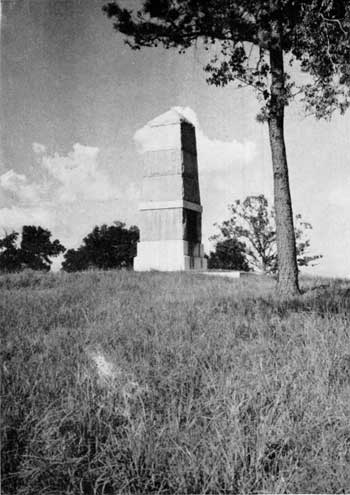 New Echota Memorial erected in 1931. |
After Boudinott, because of illness, had omitted his editorial comments from the issue of April 1, 1829 (Vol. II, No. 3), he explained apologetically in the next Phoenix: "The Editor of this paper regrets that, owing to indisposition, he is not able to render his present number as interesting as he would wish." The issue of April 22 was skipped entirely for want of printer's ink, the editor announced in the following number (April 29, 1829, Vol. II, No. 7). He published at the same time the news that Wheeler, one of his printers, had married Nancy Watie at New Echota on April 23. The paper then suspended entirely until May 27 (Vol. II, No. 8), when it was explained that the shipment of ink had been delayed. The reader is left to wonder whether a bridal trip of the Wheelers might have been partly responsible for the hiatus of three consecutive issues.
The illness of "a hand" reduced the Phoenix of September 22, 1829 (Vol. II, No. 22) to two pages and, for the first time since its establishment, there was no Cherokee type in its columns. A study of the newspaper file reveals a diminishing quantity of material printed in the Sequoyan syllabary, an indication perhaps, that the poor health of Boudinott, who still was only about 26 years old, did not permit him to devote his entire time to editorial duties. Another explanation may be found in the fact that Boudinott and Dr. Worcester were busily engaged in preparing religious materials for publication on the Phoenix press. Portions of the Bible were translated from Greek into Cherokee, numerous tracts were issued, and an Indian hymn book, first printed in 1829 at New Echota, ran through new editions long after both co-authors had died.25 Worcester began a Cherokee geography, and a dictionary and grammar were in progress when he left Georgia for the West. One investigator estimated that the press produced 733,800 pages in Cherokee within 5 years after adoption of the syllabary.26
Boudinott's bad health was noted again in the Phoenix of February 12, 1831 (Vol. III, No. 37), and issuance of the paper became increasingly irregular thereafter. Wheeler's name had disappeared by April 9, 1831 (Vol. III, No. 44) from its accustomed position in the masthead and John Candy's took that place. Finally, on August 1, 1832, Boudinott laid down the editorial banner which he had borne so well through four and a half years of wilderness journalism. It was taken up by Elijah Hicks, a fellow tribesman who later became a leader in the Indian Territory and in 1839 and 1843 was a member of official missions in Washington.27
A precise determination of subsequent events awaits a thorough sifting of the records by a patient student. Activities of the Phoenix were linked inextricably to the long and complex three-sided controversy which raged between Washington, the Georgia Government, and the Cherokees concerning the removal of the Indians to the West. The New Echota newspaper, a strong voice for Cherokee independence, was marked as early as 1831 as a factor with which Georgia would have to contend, and it soon was assailed because it was a potent weapon against white encroachment. Dr. Worcester was imprisoned that year, won a decision from the United States Supreme Court in 1832, and was released at last in 1833.
Meanwhile, the Phoenix appeared more and more irregularly. It is conceded generally that the last issue was published May 31, 1834, and that the press and types were seized by Georgia authorities in October 1835. That was after Boudinott, still a resident of New Echota, had placed his signature sincerely but unadvisedly to a "treaty" providing for removal west of the Mississippi. He represented the views of only a small minority of the Nation and his act cost him his life 4 years later in the West—a grim assassination with knives and hatchets.
The Cherokee National Council resolved in 1836 to remove its press from Georgia and set it up across the border at Red Clay, Tenn. When a wagon was sent to transport it from New Echota, possession was refused. Chief John Ross and other leaders complained to the Secretary of War that the equipment was being "used by the agents of the United States in publishing slanderous communications against the constituted authorities of the Cherokee Nation."
The tragic climax came in 1838. A few thousand Cherokees were taken West as prisoners on boats, but the majority, some 13,000, was sent in 13 overland parties on the journey of 3 to 5 months down the harrowing "Trail of Tears" to the West which, only by bitter irony, could be called "that happy land beyond the setting sun." About 4,000 died en route.
What became of the pioneer Indian printing press and its novel Sequoyan type? The National Park Service, or any public agency or private organization, could make a noteworthy contribution to the history of Indian journalism if, circumstances permitting, it might devote the required study to a determination of the fate of the mechanical apparatus which gave to an extraordinary people the printed pages that lifted thousands of common tribesmen from the illiteracy of the forest to the lettered realm of higher citizenship.
Dr. Grant Foreman, a leading historian of the Cherokee removal, writes: "In spite of my research and the examination of every scrap of evidence I could get my hands on, what happened to the Cherokee Phoenix press is still a mystery to me."28 John P. Brown, a Chattanooga investigator cited above (Old Frontiers), is "of the opinion that the Georgia Guard demolished the printing press, as that would be the natural thing for them to do with the feeling then raging . . ."29 Dr. Worcester took a press to the West with him and issued the first pages printed in what now is Oklahoma, but the claim that it was the same machinery used at New Echota appears to be open to serious doubt. Dr. Foreman is "persuaded that Dr. Worcester obtained a new press which he brought out with him and set up at Union Mission in 1835."
A font of Cherokee type, 4 type cases, and 140 matrices were received by the United States National Museum in 1911 by transfer from the Office of Indian Affairs, but those materials were transmitted in 1915 to the Cherokee Orphan Training School, at Park Hill, Okla. (now the Sequoyah Orphan Training School, of Tahlequah, Okla.).30 Although it had been believed by some students that the type was a part of the font used at New Echota, the archivist of the Oklahoma Historical Society reveals31 the existence of official records which show that the metal had belonged to the Cherokee Advocate, established at Tahlequah in 1844 as the western successor of the Phoenix and published there as the official national organ until the disintegration of the tribal government in 1906.
E. D. Hicks, a grandson of Elijah Hicks (mentioned above as the second editor of the Phoenix), who has lived in Tahlequah since birth, discloses that the press and some of the other equipment of the defunct Advocate were sold to J. S. Holden, "Who tried to run a paper in Fort Gibson (Oklahoma), but he died and what became of the old outfit I do not know."32 It appears improbable, in any case, that either the Advocate type, or that now to be found in a mixed case of English and Cherokee type stored in an attic of the school at Tahlequah,33 ever served in producing the New Echota Phoenix.
Nevertheless, even though the historic physical equipment of publication be lost forever, there still must remain at New Echota Marker National Memorial the material for an exceptional volume of stories yet untold concerning the Phoenix and its monumental work. Those stories well may deserve public recital.
Notes
1 Oklahoma and Idaho. John Clyde Oswald, A History of Printing: Its Development Through Five Hundred Years (D. Appleton & Co., New York and London, 1928), 232, 234.
2 This formidable assortment of known facts and diverting legend is reviewed by John B. Davis, "The Life and Works of Sequoyah," Chronicles of Oklahoma, Vol. VIII, No. 2, June 1930; Rodney Sydes Ellsworth, The Giant Sequoia: An Account of the History and Characteristics of the Big Trees of California, J. D. Berger, Oakland, Calif., 1924; Grant Foreman, Sequoyah, University of Oklahoma Press, Norman, Okla., 1938; George E. Foster, Se-Quo-Yah, the American Cadmus and Modern Moses, Office of the Indian Rights Assn., Philadelphia, 1885; Albert V. Goodpasture, "The Paternity of Sequoyah, the Inventor of the Cherokee Alphabet," Chronicles of Oklahoma, Vol. I, No. 2, October 1921; Samuel C. Williams, "The Father of Sequoyah: Nathaniel Gist," Chronicles of Oklahoma, Vol. XV, No. 1, March 1937.
3 Davis, op. cit., 155.
4 One school of Sequoyan genealogists favors George Guess, a German peddler from Savannah. Another rejects him with scholarly vehemence and cites Col. Nathaniel Gist, friend of Daniel Boone, Orthographical variants include Guess, Guest, Gist, Guist, and Guyst. Government records concerning Sequoyah contain the forms Guess and Gist.
5 Davis, op. cit., 156.
6 Herbert Earl Wilson, The Lore and Lure of Sequoia, the Sequoia Gigantea, Its History and Description (Wolfer Printing Co., Los Angeles, 1928), 90.
7 Most of the signs are letters of our own alphabet employed normally, reversed, or upside down. Some investigators suggest that Sequoyah adapted them from an English spelling book (which he could not read), others that he followed the print in a newspaper picked up on the roadside.
8 Foreman, op. cit., 11.
9 Davis, op. cit., 166.
10 George E. Foster, Literature of the Cherokees, Also Bibliography and the Story of Their Genesis (Phoenix Publishing House, Muskogee, Indian Territory, 1889), 23, 24. Cited hereafter as Foster, Literature.
11 The Missionary Herald (Crocker and Brewster, Boston), Vol. XXII, No. 1, 47.
12 Foreman, op. cit., 7.
13 Vol. XXIII, No. 12, 382.
14 The Council, meeting at New Echota, October 15, 1825, had authorized the expenditure of $1,500 for a press and two type fonts. Three days later it directed that an editor be chosen at an annual salary of $300. On November 2 it approved construction of a printing house "24 by 20 feet, one story high, shingle roof, with one fire place, one door at the end of house, one floor, and a window in each side of the house, 2 lights deep, and 10 feet long." On November 4 it appointed Isaac H. Harris "principal printer" of the Cherokee Nation at a salary of $400 a year. Cf. Foster, Literature, 38, 41-42.
15 Carolyn Thomas Foreman, Oklahoma Imprints, 1835-1907: A History of Printing in Oklahoma Before Statehood (University of Oklahoma Press, Norman, Okla., 1936), 10.
16 John P. Brown, Old Frontiers: The Story of the Cherokee Indians from Earliest Times to the Date of Their Removal to the West, 1838 (Southern Publishers, Inc., Kingsport, Tenn., 1938), 482.
17 Robert Sparks Walker, Torchlights to the Cherokees: The Brainerd Mission (Macmillan Co., New York, 1931), 232.
18 Grant Foreman, The Five Civilized Tribes (University of Oklahoma Press, Norman, Okla., 1934), 355.
19 Foster, Literature, 55.
20 Buried at New Echota. She bore six children. Boudinott later married Delight Sargent, a white missionary of Brainerd, who accompanied him to Indian Territory. Cf. Walker, op. cit., 155-156.
21 Foster, Literature, 51.
22 Cherokee Phoenix, Vol. I, No. 22, July 30, 1828, p. 2.
23 Cherokee Phoenix, Vol. II, No. 2, June 24, 1829, p. 2.
24 There are 96 issues in the file: 28 of 1828; 33 of 1829; 15 of 1830; 18 of 1831, and 2 of 1832. Some 250 issues are available in the library of the American Antiquarian Society but, humiliating as it may be, the most nearly complete collection of originals is not to be found in the United States, but in the British Museum.
25 A missionary wrote in 1861: ". . . they were singing a hymn in the Cherokee language. Never before did music appear half so sweet to me. The language is music itself. The air is a sweet one, and the deep feeling of devotion with which it was sung rendered it truly refreshing." Cephas Washburn, Reminiscences of the Indians (Presbyterian Committee of Publication, Richmond, Va., 1869), 42.
26 Foster, Literature, 53.
27 E. D. Hicks, of Tahlequah, Okla., a 76-year-old grandson of the late Elijah Hicks, who himself is a great-grandfather, revealed to the author, after original publication of this article, that the second editor of the Phoenix was born June 20, 1796, the son of Charles R. Hicks, second chief of the Cherokee Nation. He became clerk of the Council in 1822 and president of the national committee (the Senate) in 1827. He was a captain of one of the Cherokee emigrant detachments transplanted west of the Mississippi River, signed the Constitution of 1839, and settled on the California Trail at the site of the present Claremore, Okla. He became clerk of the Cherokee Senate in 1845. He died August 6, 1856, and was buried at his home, now the cemetery of Claremore.
28 Personal communication, February 17, 1940.
29 Personal communication, March 4, 1940.
30 Personal communication from the U. S. National Museum, February 29, 1940.
31 Mrs. Rella Looney, personal communication of March 8, 1940, with transcripts of items 2017, 2018, and 2019 in Cherokee-Newspapers, Archives of the Society.
32 Personal communication, March 19, 1940.
33 Personal communication of March 16, 1940, from Superintendent Jack Brown, Sequoyah Orphan Training School.

|
|

|
|
|
Last Modified: Sat, Oct 20 2001 10:00:00 am PDT |